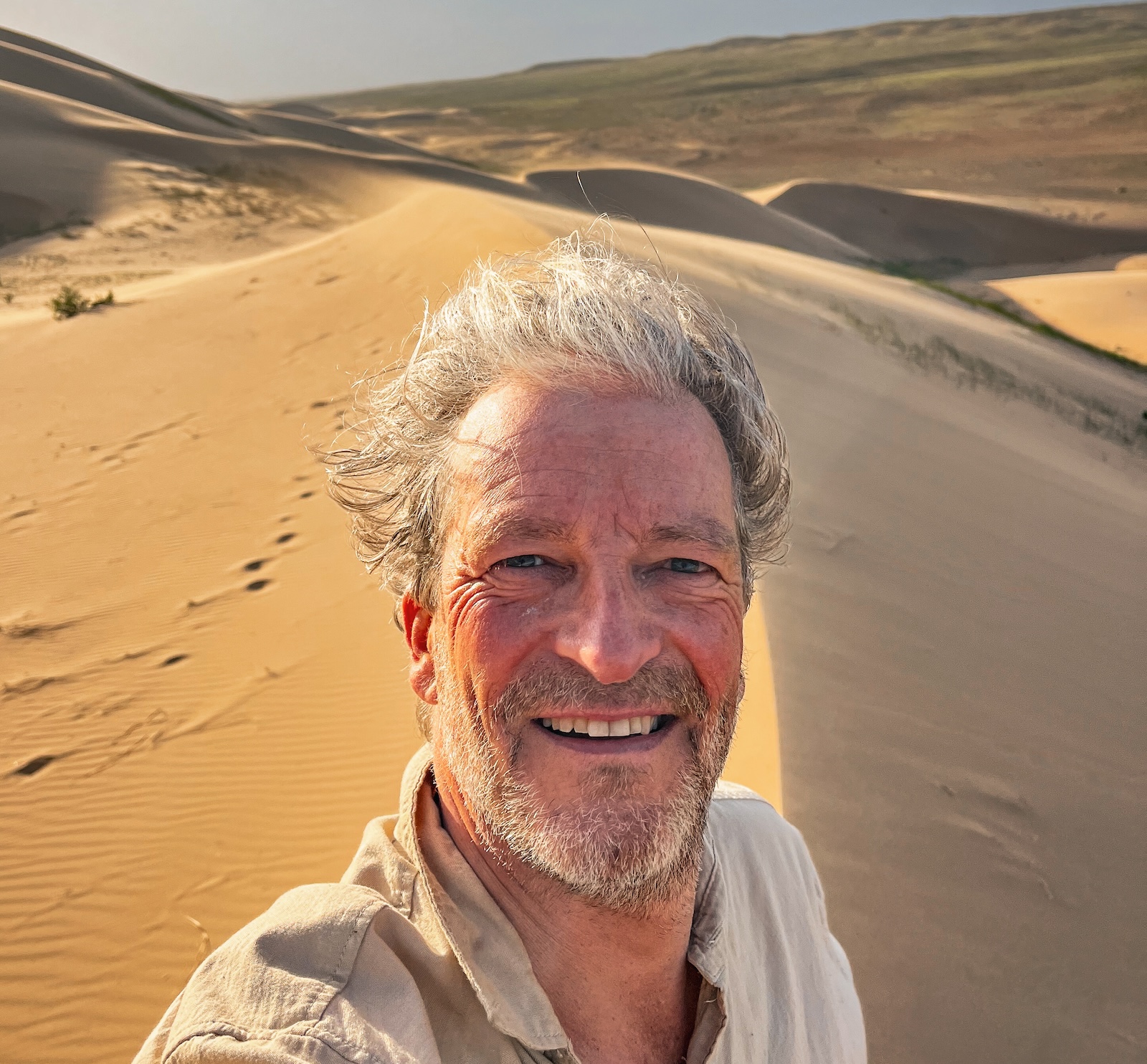
Tim Voors is a 53-year-old Dutch writer, artist, former advertising executive, father of three, and long-distance hiker who discovered a sense of belonging among a worldwide community of “happy misfits.” (timvoors.nl/@timvoors)
After 20 years of working with brands like Heineken, Booking, and Budweiser, Tim began thru-hiking in his forties, searching for the fear, humility, and adrenaline that corporate success could no longer provide. His adventures have since taken him across the Pacific Crest Trail, Continental Divide Trail, Te Araroa in New Zealand, multiple Caminos, and Japan’s 1,200-year-old 88 Temples pilgrimage, where he slept on cardboard in bus stops alongside elderly Japanese hikers.
We get into Tim’s 10-year experiment to build income streams that would allow him to earn money while preserving the freedom necessary to frequently take long hikes. The result is a patchwork of books, speaking, art, clothing, workshops, and two Airbnb units that satisfies both his financial needs and his human need to feel useful.
Tim also describes the joys of teaching painting and singing from home while wearing Crocs and Hawaiian shirts, makes the case for doing many things instead of becoming a specialist, and explains why he now feels more like a pilgrim than a backpacker.
Full transcript: dirtbagrich.com/tim
Recorded in August 2026.
Transcript
This is an AI-generated transcript. Typos and mistakes exist!
Blake Boles (00:00)
Tim Voors, welcome to Dirtbag Rich.
Tim Voors (00:04)
Thank you. Thank you for having me.
Blake Boles (00:06)
As someone who’s hiked in big, beautiful mountains all around the world, what is the the biggest and most beautiful hike in the Netherlands?
Tim Voors (00:16)
Well, I mean, as you know, we have a very flat country and it’s very highly densely populated. But we have something called the Kustpad, which means the let’s call it the beach walk. And we’re very fortunate we have a long, let’s say, five hundred kilometer beach line. And it starts with the border with Belgium and it goes all all the way up to Germany, and it’s basically a walk
Takes about four weeks, where you follow the the beach or the dunes. And it’s a very thin national park, if you will, only two miles wide, but it’s five hundred kilometers long, and it’s I mean, I just love the sea. I don’t know about you, but it always makes me happy. And we have beautiful dunes and and I did this during Corona like COVID. so that’s definitely a place I love going back to.
Blake Boles (01:16)
That sounds like a lot of walking on sand. How does your body appreciate that?
Tim Voors (01:21)
Yeah. I mean it’s if you walk close to the sea, it’s very hard sand. And then when you go up into the dunes, there’s often cycle paths and so it’s not that really heavy dune sand, if you will. it’s a very organized country we live in, so that’s why I love America so much, because it’s a bit wilder and wilder in in nature.
Blake Boles (01:45)
What are you saying? We’re disorganized?
Tim Voors (01:48)
No, I’m saying it’s raw or if you go into a national park in the States, it’s actually the land of the free. And it’s n it don’t you don’t have signs everywhere and you can put your pitch your tent everywhere. That’s something I really miss in Europe.
Blake Boles (02:02)
Yeah, yeah. You’ve hiked in New Zealand also and you probably noticed that the the signs there often give time estimates instead of kilometers.
Tim Voors (02:12)
Yeah.
Blake Boles (02:13)
how do you feel about that?
Tim Voors (02:15)
Mm. Well you see that a lot in the Alps too. you know. I don’t really like signs in general. So that’s again, that’s why I like America. I mean, I like signs if they help you for safety reasons. Like in New Zealand, they have this system where you follow the orange triangle, which is about two meters high, and that’s basically for if there’s a lot of snow that you can at least have a trail.
You know, so for safety reasons I like science, but I don’t like all this information and I really don’t like it if they, you know, tell you too much too much data.
Blake Boles (02:51)
Yeah, yeah. I found your book before I was ever introduced to you, Tim, in a bookstore in Amsterdam about your hike of the Continental Divide Trail. And I gifted it to a friend who who lives north of Amsterdam. And the reason I bought it is because it’s it’s just gorgeous. Like the design and the art, the photographs combined with really evocative text and and writing. And I was delighted to to get the chance to meet you, and I was wondering, did you put that whole book together?
Tim Voors (03:25)
I did. I I’m a kind of person that does everything and I have an opinion about everything and I’m very on details. But I work together with a very amazing German publisher, Gestalten, who make beautiful books about, you know, cars and tiny houses and design. So they really do add the design beauty and they really do think about the color of the white of the paper, but all the artwork and all the photography and all the writing is mine. So it’s it’s it’s a really pleasure but also a very humbling to work with such a great team, ’cause they really do add to the whole yeah, the whole design experience.
Blake Boles (04:17)
So was hiking on the Continental Divide Trail the wildest experience you’ve had? Or maybe would that go to the Teororoa in New Zealand?
Tim Voors (04:27)
No, I think like I said, America is wild. And the the the Continental Divide, the the the famous tagline for that trail is the Continental Divide Trail does not like people.
Blake Boles (04:42)
Ha ha.
Tim Voors (04:43)
so it’s really badly maintained. which means you’re sometimes walking over blowdowns the whole day. there’s lots of alternates so
Sometimes you have to find the trail. it’s you know, that whole section in Colorado is very high. So I you get headache because of the altitude. you have more dangerous predators. So yeah, I it i it it in the end it was okay and it was great and I loved it. But the imagine having to walk through Grizzly Country for five months.
And sleeping in Grizzly Country in a tiny tent, it took me four years to mentally prepare myself to become ready to actually dare to do something like this. so I think the the rawness and the intimidation of the miles and the rawness and the animals, that’s the real fear is in your head in the years building up to a hike like this.
Blake Boles (05:56)
For someone who finds you online, they’ll see a lot of really incredible photos of you out there hiking long trails or being on one of the Camino routes in Spain. And they’ll also see some names of like larger companies or corporations associated with your your previous marketing and and design work. And i I I bet it leads a number of people to scratch their head and be like, is this guy working full time for big companies in in Amsterdam? Is is he just out there hiking all the time w without any work? you could also look at your Instagram and think, is he a an artist just teaching other people how to draw and paint? You you seem to have multiple existences under one umbrella. Which which one is the true Tim at this moment?
Tim Voors (06:47)
Well, it’s I do like you seeing that. I think the true Tim is that I strive to do it all. And I tr don’t strive to be great or perfect at everything. that’s I’ve never tried to become a winner. But I do find doing one thing very boring, so I love doing painting and writing and hiking and working for big companies. So I think it’s I really like your question because that is who I am and who I strive to be. Not in in any form of perfection, but just I don’t want to be put in one little box. And I love to express myself and I love to paint and I love to write. So yeah, I think that’s the short answer.
Blake Boles (07:42)
Hmm. Did you have a dirt bag side to you earlier in life or did you have a more professional existence that you managed to shed at some point?
Tim Voors (07:53)
No, I think my parents very much gave me my dirtbag side from a very Calvinistic perspective. I don’t know if you know this. You know, it’s
Blake Boles (08:04)
I’m familiar, but but spell it out for us.
Tim Voors (08:06)
okay, so it’s obviously some people have been brought up religiously and Calvinistic is basically the a philosopher who founded the Protestant church. And basically it’s in the churches it’s very sober and there’s no there’s no big there’s no gold like in the Catholic Church. So basically being Calvinistic is not necessarily religious, but it’s very be c it’s very humble, being very grateful, without lots of luxury. So basically our holidays would also always be in the Alps and we would camp and we would cook on fire and we would swim in the in the streams. So I was brought up with this very, you could say purist or natural or grateful attitude. so now that when I started through hiking ten years ago when I was like fift forty two, I like that things are not luxury. I like that things are simple. I like that I don’t have to wash for for a week.
I see the beauty in earning something, you know, so drinking a beer at the top of a mountain because I walked up that. So it’s I’m also romantic, so you know, walking through the rain for three days obviously breaks the spirit. But if you still see the beauty in that you’re very fortunate to be fil healthy and have legs and still be able to do stuff like this, I think that that’s not dirt bagging. But it allows you to appreciate the dirtbag side of life.
Blake Boles (09:58)
Yeah, you’re on to something there, which is I I think something that a lot of people who are who are not raised with low expense vacations but are, you know, taken more on vacations or taken to resorts, Disneyland, theme parks.
Tim Voors (10:17)
Yeah. Yeah.
Blake Boles (10:19)
it’s something that is is rediscovered and I think a lot of people who do end up using the term dirt bag th they find their own little the Calvinist interpretation of of how to be in in the wilderness. but I imagine growing up in the Netherlands, even if you got to have these these very rustic vacations to the Alps, y you’re still, as you mentioned in the beginning, growing up in a very densely populated, very flat country and a lot like America, with a lot of drive to succeed professionally. And what was it that started to tip you in the direction I mean, if you didn’t start through hiking until your forties, I mean, a lot of people think that they’re too old to through hike once they hit their forties. And so what was it that that started nudging you in that direction?
Tim Voors (11:11)
I think it I basically my answer is I don’t know. But I think I do have a thousand answers. so I didn’t have one reason which nudged me, but I think I was very much a father of a b big family and had a mortgage and had a corporate job and earned a lot of money. But I think what I really need in life is to be feel challenged.
And if you become quite good at your job and you start winning stuff and you kind of become a bit too big for your boots. And if you’re not careful, you can even become arrogant or ungrateful, or if you get kind of get what I mean. Plus, if you do your if you’re good at something in your corporate job, you kind of become a one-trick pony. So rep things are sort of fun and successful and you kind of keep doing what so I think what happened after twenty years of fast corporate life, I just I didn’t realize it, but I kind of got bored. And I needed something that put me down a lot of notches and made me intimidated and excited and scared and like you are when you’re a child. So I think when I heard about I read the book of Cheryl Strayd, Wild, and I was like so impressed by this young woman. She was 26, and then she walked across the American. I was like, I I hope one day when I’m old and wise, that I’ll be as brave as she is. And I think I just had to go on an adventure that was so intimidating that I would become humbled again by nature. And that excited me, and that gave me adrenaline. That I was missing in my corporate job. Do you kind of follow me?
Blake Boles (13:10)
I do. Yeah.
Tim Voors (13:11)
Yeah.
And I didn’t realize this at the time. So it kind of sounds smart if I kind of say it to you now. It was just a gut emotion. I have to do this. I have to do this. And if someone asked me why are you doing this, I say, I have no idea. And if you ask me why I’m doing it, I have no idea. Like, you know? I still have no idea, but I just love it.
Blake Boles (13:38)
Did anyone tell you you were having a a midlife crisis?
Tim Voors (13:42)
Yeah, but you know, I’m I’ve I’m fifty three, I’ve been having a midlife crisis all my life. I love it. I mean you
Blake Boles (13:50)
I love that response. Yeah.
Tim Voors (13:52)
know, a crisis there is something negative about that word. And I think a better answer is sometimes life is a bit boring and I want to live. Is that then a crisis? As long as you
Blake Boles (14:05)
It’s a manufactured crisis.
Tim Voors (14:08)
It’s it’s just you know, as long as you make it work for your partner and your children and your company and your finances, and you’re not hurting anyone by following your dreams and also allowing others in your family to to be able to follow their dreams, I don’t know why that has to be called a crisis. And I would actually like to flip the question, if I may.
A lot of people in in Europe, especially in Holland, are having burnouts at work. I mean, it’s like fi five percent, maybe eight percent of companies have people at home because they’re stressed, unhappy, depressed, you know? And I would argue going following your dream and going on a long walk, even if it’s for a long weekend, it could actually help prevent this actual crisis where you become unhealthy.
So I like your question, but I think it’s not really the point whether I had a crisis or not. I just do stuff and try to make sure that no one has a crisis as a res as a result, and me included.
Blake Boles (15:24)
Yeah.
Yeah. Yeah. Yeah. Listen, I’m I’m on board with you and and I love embracing
Tim Voors (15:29)
Ha ha.
Blake Boles (15:30)
the the idea of the crisis and say, Is this really a problem? It sounds like an invigorating change in your life and it sounds like you’re actually mustering up the the courage to to do something that’s been building up inside of you. If that’s what we mean by crisis, then more crises, bring them on.
Tim Voors (15:47)
Yeah, and and and to also put it into perspective, I mean I have had crises in my life and I know people who have a midlife crisis, they’re very painful and they’re not nice. So I don’t want
Blake Boles (15:58)
Mm.
Tim Voors (15:58)
to, you know, if you if pe if people actually have a crisis with the relationship or with themselves or with their work, you know, that’s just horrible. I think I was trying to prevent that from happening. Is if you kind of follow my
Blake Boles (16:13)
Hmm. Yeah, yeah.
Tim Voors (16:15)
so
Some people will be very loyal to their company and they’ll work for until they’re sixty five. And I just didn’t buy into that concept.
I think that’s yeah.
Blake Boles (16:25)
Let’s go back yeah,
l and talk about your your career and and what your your f first part of of life looked like. And and and just for the record, although you didn’t start doing a lot of long hikes until roughly ten years ago, you had hiked on the Camino de Santiago in Spain before. You you had a taste for for medium distance hiking.
Tim Voors (16:45)
Yes. Yeah, yeah, yeah. Yeah.
Blake Boles (16:50)
Yeah, okay. yeah, but tell me about your your earlier career with
Big corporate clients, high income. Tell me what that looked like.
Tim Voors (16:59)
Well, I was a designer, but I was a really bad designer. so I decided to be an idea guy. When and advertising, I love the sort of rock and roll like side of fast pace. And so I slowly made my way up the ladder of advertising. But I became the internet guy when I can remember I I made the first website for the Dutch AT ATT.
yeah, so I was very much always one day ahead of my competitors because I understood internet. And a long time that was very w badly paid, but obviously at some point that shifted and I kind of became the cool kid in the in the street because everyone wanted a website.
Blake Boles (17:53)
Mm.
Tim Voors (17:53)
So that’s kind of I kind of got lucky and I didn’t really like working for companies.
Perhaps I have a little bit of an authority issue. I like things to be fair, but I don’t like someone talking down to me. so at the age of 30, I decided to set up my own company, which is basically freelancing for the big American and Dutch advertising agencies. And I was basically always the internet guy. and I kind of rode that wave.
And did great things for Heineken and Booking and Budweiser. And yeah, I mean, you could imagine at one point there was a World Cup in South Africa, and Budweiser was the first was the official beer sponsor. And we had the boarding along the pitch, and it said Bud House, which was the first YouTube yeah, let’s say sitcom, live sitcom.
It was on YouTube. It was so that was all my project. So I I kind of got to do some cool stuff. And I was earning good money and I was supporting my family and kind of enjoying the the wave. But and and I really enjoyed working for myself and then I created a foundation for all the other freelancers. So yeah, that was basically for a long time my career.
Blake Boles (19:28)
And did you feel meaningfully engaged in in this work? Did you feel like yeah? is
Tim Voors (19:33)
Absolutely. I loved it.
Blake Boles (19:35)
I mean tell me like making the the the YouTube sitcom for for Budweiser like like what is it that feels like meaningful about that to you and it and I’m not trying to lay any judgment here. I’m j genuinely curious, like what lit you up?
Tim Voors (19:51)
I think just solving a problem, a puzzle. Let’s say the problem was the briefing. Budweiser wanted to engage with the European audience, because no one knows Budweiser in Europe. And yeah, just working with amazing designers, try trying to please the client, please my client. yeah, working late.
With a lot of criticism, a lot of moving parts, and trying to just make something creatively as beautiful as possible, although it’s very commercial. So I never had the the ethical problem with working for big brands. And I I still don’t. I’m I’m always grateful that someone will allow me to solve their problems. But having said that, I’m very grateful that I don’t have to do that anymore.
Blake Boles (20:50)
Yeah.
Tim Voors (20:50)
But it’s not like I I’ve never had a an aftertaste of this is big money or they’re just trying to so I guess I’m lucky in that respect that I’ve never had this moral yeah sort of complicated discussion with myself.
Blake Boles (21:09)
Yeah. So why are you happy that you don’t need to work with these clients anymore?
Tim Voors (21:13)
Well
that that’s a really nice question, Blake. I n didn’t realize it, but now these days I welcome people into my home every every day and I have opened a school and I teach people about long distance hiking. And I teach people how to people who have always said to themselves, I can’t paint. I teach them to paint and I I teach them to sing. And it’s just so moving and touching to see people in front of you, just normal people like you and me.
Just go home with newfound confidence. I’m gonna paint when I’m on holiday. And that makes me really happy and proud. But all the tricks and that I learned in corporate life, I actually am able to use in my teaching.
Yeah, I’m just s very fortunate.
Blake Boles (22:11)
w walk me through that. You you’ve got me hooked here, Tim. What corporate tricks do you use teaching people hiking skills, painting, singing, etc.?
Tim Voors (22:20)
You’ve got to imagine if you if I’m sitting in a big room in a corporate office with you know with 15 people from Budweiser, and I have to convince them that my idea is great and that they’re gonna spend all their money on that idea, you have to structure a story that actually at the end of the meeting they go, Okay. So you basically learn to sell things in advertising.
Now, teaching is not very different. You have to take people through a process that they step by step that they make it their own. And that at the end of the day, they say, I’m actually good at painting. And the same goes if if I’m negotiating with a publisher to write a book, I’m selling an idea. Do you do you get what I mean? And and there’s probably lots of other tricks that I’m unaware of that you kind of
<unk>S
Well f shall I give you one other example?
Blake Boles (23:26)
Yeah, please.
Tim Voors (23:27)
So you know clothing is how important clothing is in corporate life. You know, if it’s a big meeting you wear ties and if it’s informal, these things all say something and something I learned in America when I was through hiking the PCT. we stayed at Casa de Luna, which when we stayed there, everyone had to wear it was at someone’s house, you had to wear Hawaii shirts.
And I just love this idea. So now when people come to my school, before we start, I invite them to wear a Hawaii shirt that I have here for them. And immediately, as soon as everyone wears those happy, colorful shirts, they become a group. And they step out of the identity that they used to have when they came in with their, you know, fancy clothes or baggy clothes or whatever. And it’s such a simple tool or trick.
That immediately a group of people that never knew each other suddenly feel connected, and that’s through clothing.
Blake Boles (24:30)
Hm.
Tim Voors (24:31)
And it’s so all these things contribute to
making creating a safe space, I would say.
Blake Boles (24:44)
Hm. It sounds like you have found a really interesting and and like
socially positive way to escape the possibility of of burnout. And I feel like that is what a lot of people are are looking for maybe at that same moment, maybe around age 40, when they’re like, all right, I’m a one trick pony. I’m good at making money. Maybe
Tim Voors (25:11)
Yeah.
Blake Boles (25:11)
I don’t even have many, you know, ethical concerns about working with l large
Tim Voors (25:15)
Yeah.
Blake Boles (25:15)
shadowy corporations. But you know, what else could I be doing with these same skills and
How could I not look back at age sixty something and think, wow, I really just did one thing for the past forty years? And and you get to actually invite people into your your house and put Hawaiian shirts on them and and teach them how to sing and and
Tim Voors (25:35)
Mm-hmm.
Blake Boles (25:35)
make art and I mean this this sounds pretty idyllic. And and then you go off and you get to go on long distance hiking adventures. Do you leak guided trips also?
Tim Voors (25:47)
I do actually, but I really like your question because I do and I don’t, because I think guided trips in the mountains are very dangerous. And you know this better than I because you guys in America love to sue people.
Blake Boles (26:01)
Ha ha.
Tim Voors (26:03)
in in Europe we don’t do that, but you know, if you if I guide someone in the mountains and that person should break a leg or go blind or die, then I also have a problem here in Europe.
So I’ve just created a really interesting format that I there’s this woman called Nikki Brauer, and she lives young woman, she’s like 32, and she lives in Austria, and she’s like a certified mountain guide. And she’s also created a really big company called She Feels Alive in the Mountains. And she does 50 guided mountain.
Treks for groups, let’s say, of 10 to 15 people every year. And all her employees are young women who are mountain guides. So what I’m now doing, I’m giving mountain guides, but with her guides. So they are the professionals and they do the booking and they all the payment goes through them. And then I’m the sort of happy sidekick who gives painting classes in the mountain huts.
And in this way it feels I feel secure because I’m with a very good mountain guide, but I also don’t have to carry the responsibility of the liability of the group. And that’s something I do think about a lot.
Blake Boles (27:31)
I mean, it sounds very similar to your exit at age 30, from being an employee into being a a freelancer. Like you still get to interact with people, have meaningful relationships, but you don’t have all of the the liability and the the assumptions that come with like you work for me, therefore
Tim Voors (27:49)
Yeah.
Blake Boles (27:50)
X, Y, Z.
Tim Voors (27:52)
Yeah, because I’ve I really I think that’s probably why I never had employees. I really feel that responsibility for people very heavily. And I think that would give me fear and stress, where other business people don’t feel that. And I I know I I respect people who are business people who have employees. I just don’t dare. so basically my past
Business model of the past two years is basically collabing with people who are better at something than me. And so, like Nikki, you know, working together with her or working with brands that make amazing stuff, but are, you know, I can really add something. So I really like to work together with people and I don’t like to carry the entire responsibility.
Blake Boles (28:44)
Mm-hmm.
Mm-hmm. So let’s talk a little bit about the financial side of things. And I’m going to make some assumptions and you tell me if these assumptions
Tim Voors (28:53)
Yeah.
Blake Boles (28:54)
are correct. your your high-flying corporate life in your twenties and thirties funded the the house that you now own, helped you raise three kids,
Tim Voors (29:07)
Yeah, yeah.
Blake Boles (29:07)
have the the sort of like nice Dutch lifestyle living not too far from Amsterdam.
And then that allowed you to then feel a bit more relaxed about transitioning into these other, you know, mu much more broken up, much less reliable possible streams of income, like doing freelance artwork, leading some workshops, writing some books, doing some public speaking. was freelance marketing, advertising work still part of that equation?
Tim Voors (29:39)
Yeah. So let’s just go back ten years. so you’re right. I I I was a freelancer and and it was it was still scary because you never knew if you would get a next job, you know, so in that respect it was entrepreneurial. But I was sort of hustling and I kinda made it work. So the good thing was at the beginning that I would I could work, work, work and then I could save, save, save.
And then I would have enough money to do a crazy hike, but I could also make sure that there was enough money for the family w wh while whilst I was gone. So that was kind of lucky, if you will, because I could manage my own time as long as I saved up enough. and obviously when you’re walking, then I wasn’t earning any money. So the expensive thing about walking at the beginning was that I wasn’t earning while I was hiking.
And that all the costs continued. So when I returned from the PCT, I was thinking very much about your question. Like, how can I change my business model that I can actually earn money while I’m walking? Now, a lot of people usually laugh when I say that because it’s like everyone’s like, yeah, fuck, I I would like that too. But that was my central question to myself when I returned from the PCT. And I basically
I did a sort of mind game with myself. I said, okay, Tim, you’re supposed to be good at your job at solving problems for big brands, right? Budweiser asks you to solve a problem. So why can’t I solve a problem for myself? So basically, I turned the script where I wrote a briefing to myself, and I decided to put it on one A4 and just with five words. And it was basically, how can I generate income?
without physically or mentally showing up. That was basically my briefing. And I gave myself 10 years the time to solve that assignment. I said, I don’t have to be rich, I don’t have to earn a lot of money, but in 10 years I have to earn money without showing up. And that was my briefing. And the weird thing was we are so addicted to the
The working for companies business model, that it’s really difficult to step away from that, I will work for you, you will pay me for my time. It’s really addictive
Blake Boles (32:12)
Mm.
Tim Voors (32:13)
because you know you you know how it works and you kind of get the money. So coming up with ideas to generate passive income was is very difficult. but again, it was my assignment. And that’s case basically how the whole journey started 10 years ago to slowly.
Challenge myself, try this, try that, think about this, talk about talk with these people. And that’s how it started. So I I just gave myself a very long time to solve that problem. And I don’t like say I don’t like borrowing b money from banks. So I didn’t want to do any scary big investments, but I am creative and I do like to work hard. So and you can just try stuff. And that’s basically how it started.
Blake Boles (33:02)
So you now live the passive income dream life, tens of thousands of euros pouring into your bank account every month. you’re staying
Tim Voors (33:11)
Mm. No but
Blake Boles (33:13)
staying at f five star hotels in the Alps a as you hike along.
Tim Voors (33:16)
No, because I s
so I think the that’s the point. I didn’t want to become rich. passive means that you can just get by. but it is true that I now have about seven different income streams that are not very big, but if you add them all up, yeah, you know, they they pay the bills and I can I can try this and I you know so
It’s not and it’s I haven’t succeeded in in the you know, I may be seventy percent there and it’s always a struggle. but it’s the think the point I’m trying to mind make, it’s a mindset. And we all work very hard and we put a lot of effort into our work and we put a lot of effort into our life.
So I basically said, why can’t I solve this problem? Do you get what I mean? And and it’s really difficult, but so is go turning up to a job forty hours or fifty hours a week. You know, so
Blake Boles (34:25)
Yeah. Well tell tell
me about some of these these income streams, these projects. just d more details the better, please.
Tim Voors (34:31)
Yeah. Yeah,
yeah, of course. So I was walking across Holland with my wife and we were staying at families’ homes, you know, you for let’s say twenty-five dollars and you could sleep up in their child child’s bedroom or and one night we stayed at a people and they had converted the garage into a let’s say a bed and breakfast. It was really simple and I was lying there. I was like, you know what? I I think I could do this. I have a you know a
bicycle room in my house with you know with with a larder with lots of sort of you know with stuff in it if I take that all out and I convert it into a bed and breakfast yeah so basically I I saved up we put 10,000 euros of savings into converting it into a bed and breakfast and we earned 10,000 that year so paid s paid paid off the investment if you will.
And then we started earning with it. Then I went on another big hike to across New Zealand and I came back. I was like, why don’t we do this again? So I built an I worked for a big bank, saved up the money, and then we we made an extension. So I built a second B BNB. So I was fortunate to have already bought the land, if you will. but I think so. Then we had two Airbnbs. So that
obviously generates money. And then I started writing books and then I started giving lectures and now I’ve set up a school and I now have my own clothing line. So I just like coming up with stuff and some of my projects fail miserably. And it’s not like all these projects generate a lot of money. Like writing books you don’t really earn very much money. But by writing books you get credibility and then I get invited to give lectures.
Blake Boles (36:27)
Exactly.
Yes.
Tim Voors (36:28)
So
I am at a point where everything is interconnected. And I am at a point where now brands want to work with me. And I’m like, well, I would like to work with you, but I want my own cloth clothing line. So
It’s it’s been a 10-year journey, and again, they’re not very big income revenues, all these things. But again, if you add them all up, it is something.
Blake Boles (36:58)
Yeah.
Tim Voors (36:58)
And I’m so fortunate to be a teacher in my living room wearing my Crocs in my Kawaii shirt and making people happy.
Blake Boles (37:08)
Yeah.
Tim Voors (37:08)
You know, so it’s not so much about the money, but it is true that the
these small income things do generate time
Blake Boles (37:16)
Yeah.
Tim Voors (37:17)
that I don’t have to work for the company corporate life anymore. So it’s it’s like I said, it’s been a ten year, eleven year journey and I haven’t succeeded and I have. You know, so
Blake Boles (37:31)
Hmm. And i
if you’ll allow me to be a bit pedantic, it sounds
Tim Voors (37:36)
Yeah.
Blake Boles (37:36)
like just a few of those income sources are are what I would call passive income, the the book royalty income, the income from art or or clothing brand sponsorships. but it sounds like I don’t know, someone has to turn over the beds for the Airbnbs, you know, speaking obviously.
Tim Voors (37:53)
Course.
Blake Boles (37:56)
teaching. so it it sounds like while
you have you’ve done some passive income type things. You still really like interacting with people. I I bet you like
Tim Voors (38:06)
Yeah.
Blake Boles (38:07)
meeting the people who come and and stay in your garage. You you love putting Hawaiian shirts on on people. is is
Tim Voors (38:13)
Yeah.
Blake Boles (38:13)
the speaking meaningful? Is that is that fills you up? Yeah.
Tim Voors (38:16)
it’s I love it. Yeah.
It’s it’s very humbling and empowering ’cause if you get three quarters of an hour with an audience of two hundred people and you you take them on a story,
Blake Boles (38:29)
Yeah.
Tim Voors (38:30)
and you can touch the lives of maybe three people in the space that will actually make a life changing decision to actually go on a solo hike for the first time in their life. You know, you’re
Blake Boles (38:42)
Yeah. Yeah. And you need to
be in person for that. I mean bo books
Tim Voors (38:45)
Yeah.
Blake Boles (38:45)
help, but if someone gets to meet you and you you chat with them, then they’re like, you know what, Tim, you’ve inspired me. I’m going to go hike the Camino, I’m going to walk along
Tim Voors (38:54)
Yeah.
Blake Boles (38:54)
the coast of the Netherlands, whatever. Yeah. I the reason I’m asking this is because I I think like many people felt enamored with the idea of of passive income early on in life in my twenties. And then at some point I just realized this is a really false
God, it is
Tim Voors (39:12)
Yeah, yeah, yeah.
Blake Boles (39:13)
it it’s it’s actually not that satisfying. Like in in a way, creating the thing that then people buy and if they love it so much they tell their friends and all of a sudden you just have money poured into your bank account. Like that’s cool, but I think it’s cool from this perspective, like you said, with your corporate clients of just trying to solve a problem. Like, can I build this little this little money machine and that do it in a way that that hopefully helps people or at least doesn’t harm anyone.
But at the end of the day, it’s these like things that we do with real people and build actual relationships with people, even if it’s just a very temporary container that we’re in, which which is the real payoff. And like i if I had
Tim Voors (39:56)
Yeah.
Blake Boles (39:56)
s you know, 10,000 euros a month just flowing into my bank account from some stuff I’d produced, I would still be very much at risk of like an existential crisis of the bad kind. And
And burnout, I think, because you know,
Tim Voors (40:11)
Mm.
Blake Boles (40:11)
w we need to feel useful to other people. And it feels like you have really landed on that, like a unique combination of different ways for you to use the skills you’ve built up, but you like you are being useful to people in a small scale local, like I can feel the lives that I’m changing, kind of way. That I mean, to me that’s what makes you wealthy.
Tim Voors (40:33)
Yeah, well it’s it’s beautiful thank you. It’s nice nice that you say that. I yeah, I do feel very rich and and I also have my problems.
Blake Boles (40:47)
Certainly.
Tim Voors (40:50)
and I also struggle to make it all work, but I think coming back to one of your first questions, I just I think the answer perhaps is that you don’t have to choose.
You don’t have to choose the the the passive income model as the only thing. I think just I like to embrace the idea that you can be a writer and a painter and you can be a singer and and a and a corporate you know, work for Budweiser. it’s I think that gives if you embrace that thought, then it gives it’s
It you give yourself permission to just do everything. And then it I would be very happy with those ten thousand coming in every month because then it gives you time to do other stuff. Do you get what I mean?
Blake Boles (41:46)
Course.
Tim Voors (41:48)
but I think it does begin with a sort of flo permission to yourself that you don’t have to be one or just two things. and perhaps that’s just my character or how I was brought up and
If if I may, there’s a really nice side story.
Blake Boles (42:07)
Yeah.
Tim Voors (42:08)
I recently wrote a letter to my primary school teacher. He was 90 years old, and I wanted to congratulate him. And I said, you know, I do this and I do that and I do this and I do that. And do you know the the term jack of all trades?
Blake Boles (42:25)
Yes.
Tim Voors (42:26)
it’s kind of looked down on a little bit, right? It’s kind of like, yeah, jack of all trades.
I I do a lot of things, but I’m not very good at ever anything. And this teacher of mine, he was he did everything. He was a teacher. He built his own boat with his hands. He built his own h house. He was also a preacher in the weekend. He was he worked in in America and also in England. And he was a very humble man and never earned much money. And I basically said, Well, that’s kind of what I’m doing too. So
And he used to t tell me about Leonardo da Vinci, who would you know, who’s a poet and he was a scientist, and he was a painter and he was a architect. And he loved that guy. And so basically I wrote a letter to him saying, Well, thank you for being my inspiration because you were my Leonardo.
And it kind of gave me the permission to say to mys myself, being a jack of all trades is actually great. Imp instead of not being a very specialist and I’m I’m not very good at one thing. You know. So that that’s why I had th thanked him for sh giving me the ex example that it’s actually great to just embrace the plurality of life.
Blake Boles (43:49)
When I was twenty, I picked up this book that was very important for me called The Teenage Liberation Handbook. The subtitle was How to Quit School and Get a Real Life and Education by Gri Grace Llewellyn, who also runs Not Back to School Camp, where I recently finished working. the first time I worked there was 20 years ago. And in that book, she has a chapter titled The Glorious Generalist and talks about how
school often tries to get us to become specialists of one kind and of course this continues in in higher education and and and really you you can become highly credentialed and and well compensated when when you hyper specialize. But she made this argument that, you know, the people who are most interesting to be around and hang around and often seem the most satisfied are these glorious generalists who
Tim Voors (44:43)
yeah.
Blake Boles (44:43)
can go from talking about one thing to something that seems totally different and
therefore have the chance to connect with almost anyone who they encounter.
Tim Voors (44:52)
Yeah.
Blake Boles (44:53)
That always stuck with me. Yeah.
Tim Voors (44:55)
Yeah, in in in the in the through hike scene, if you if you live especially in America and New Zealand, if you hike for half a year across America, you basically look around these wonderful people and they’re all happy misfits. They don’t actually quite fit into society that well. and I love this sense of the celebrating the hap happy misfit, because in the end of the day, everyone is a bit of a misfit.
But yeah, it’s it’s another wording of what you just said, the generalist.
Blake Boles (45:34)
Tim, I would feel remiss if we didn’t talk about some of your hiking adventures since that’s where you’ve spent so much of your time. Let me see if I’ve got your your hiking CV down
Tim Voors (45:45)
Mm-hmm.
Blake Boles (45:45)
here. You’ve hiked the Camino Frances, which is what most people call the Camino de Santiago multiple times. You’ve also hiked the Camino del Norte and the Camino Primitivo. Any other Caminos that I’m missing?
Tim Voors (45:59)
no, I think you got it.
Blake Boles (46:02)
Okay. you’ve hiked was it the entire Teoroa in
Tim Voors (46:06)
Yeah.
Blake Boles (46:07)
New Zealand? Okay, that’s a hardcore trail. Just want to throw that out there. This is not to
Tim Voors (46:11)
A lot of mud.
Blake Boles (46:13)
a lot of everything. you’d hike the Pacific Crest Trail, the Continental Divide Trail. I’m sure people ask you, Are you gonna hike the Appalachian Trail also? to which you respond you will.
Tim Voors (46:25)
Yeah, I will. I will, but
y it I have to find my moment.
Blake Boles (46:29)
Yeah. you’ve also hiked the fisherman’s trail in Portugal, which I hiked with a friend back in January. And I’d love to to tell you my favorite thing about that trail. And I I’m curious if you notice this also. The all you can eat sushi places. Just
Tim Voors (46:46)
Really?
Blake Boles (46:48)
in every other town along the way. So maybe this is new, but they
they have all you can eat sushi places that seem
Tim Voors (46:55)
Well
Blake Boles (46:55)
really good. You pay about 17 euros
Really, you can get anything you want, including all you eat sashimi. It blew my mind. I was eating
Tim Voors (47:02)
Wow. Wow.
Blake Boles (47:04)
so much sushi on that trail. I’m like, I am not suffering at all.
Tim Voors (47:08)
No. I mean I have to say I’ve hiked around the world, but for me the Fisherman’s Trail is my favorite. I think it’s the the most beautiful colours and the combination of it’s it’s the perfect trail for people to start long distance hiking. Just four days and it’s the fish and eating for like, you know, like you said, like 15 euros for a beautiful fish and and the colors. I just love that trail.
I do it like every
Blake Boles (47:37)
Speci
Tim Voors (47:37)
every year.
Blake Boles (47:38)
you’ve done it multiple times. So to me that that southern coast too, as opposed to the slightly more wild and and windy Pacific, like wet west facing coast, but the south facing coast
Tim Voors (47:50)
Yeah.
Blake Boles (47:50)
is just like idyllic. Wow. Some of those coves just
Tim Voors (47:54)
Yeah.
Blake Boles (47:55)
magical.
Tim Voors (47:56)
I love the fisherman’s trail. Yeah.
Blake Boles (47:59)
And you’ve also hiked in Japan. I’ve never been there
Tim Voors (48:01)
Yeah.
Blake Boles (48:01)
before, but you hiked around an entire an entire island, in Japan. I’ve never heard of the Eighty Eight Temples Trail. Can you tell me something
Tim Voors (48:06)
Yeah.
Blake Boles (48:09)
about it?
Tim Voors (48:10)
Yeah, w the funny thing is it’s actually my first trail. I’ve just written a book about it in Dutch. it’s it’s called The Circle. And basically I was I went to Japan ’cause a friend of mine, he was the ambassador of Jap let’s a Dutch ambassador in in Tokyo. So I visited him and then I I checked out a a a route to go to walk and he also likes hiking. So we did
It were like let’s do a long weekend of the of the eighty-eight Temples trail. And it turns out it’s I did the the the four days with my friend and then I called my wife and said, I just love this. I think I have to finish the circle, which is six weeks of walking. So I called my clients, said, Well, I’m not gonna be back for two months. So and then I walked
around the island and I didn’t have a tent, so I slept on cardboard on in in bus stops.
So it was a very interesting. Yeah, I had this big company working for, let’s say, the Budweisers of this world in Amsterdam. And then I was hiking for two months and sleeping on cardboard. So it was a and just loving the whole Japanese culture. But this is a Buddhist pilgrimage that has existed for twelve hundred years. And you walk all in white and one of these hats, you know, these Vietnam hats and a
religious wooden stuff. It’s very religious and I yeah, so it’s you kind of step into this old history of Japan and you visit eighty eight temples and it’s a lot of road walking, but I loved it.
Blake Boles (49:55)
And just to be clear, were you sleeping on cardboard in bus stations because you wanted to or because there was no other choice for accommodation or you’re saving money?
Tim Voors (50:02)
Mm
it’s it basically I I don’t like to book ahead. so I don’t like to plan and book hostels along beforehand. So I just like to turn up and see what’s possible. And basically when I did this they were all full. So then I found these old Japanese men, hikers, that were sleeping in in in tents on the street.
Kind of like hobos, but they weren’t. And I just really liked I just thought the hotels and the hostels were really boring because you’re just in your own room and you eat and you go and shower, but yeah, I just missed the interaction. And then hiking with these three old men who were camping on the street. So I just slept, found some old cardboard behind the supermarket, and I would just sleep on a bench next to them.
And I just felt I belonged to them and I loved it. And I felt my sense of adrenaline and adventure just went up. I did actually halfway through get a yoga mat from someone, so that was like a big upgrade.
Blake Boles (51:17)
Ooh, indulgence.
Tim Voors (51:19)
Exactly. But I don’t know, I d I don’t I don’t need luxury. I just love being part of a group of people that I love. And then
Blake Boles (51:28)
Yeah. Well
Tim Voors (51:29)
I was happy.
Blake Boles (51:32)
mean it sounds to me like you need connection, Tim. And isn’t it interesting?
Tim Voors (51:34)
Yeah. Or I say it’s not even that. I
think it’s it’s deeper. I need to belong. I need a sense of belonging. And I don’t know if you know that you must have this feeling because you’re also do a lot of adventures. I think what what I realized when I was forty two in this case, I had my friends from college and my family and my friends in my village. But when I started hiking, I met this group of people.
All strangers, and I was like, These are my people. This is the group I belong to. And it just, and then I walked to America and I was doing the Pacific Christian, and I met all these 18-year-olds and these 17-year-olds, and they’re like, This is my people. And I felt so grateful that I found a new sense of belonging. And it’s it’s like it’s like coming home. And I felt so lucky that I met a new group of people at let we let’s say relatively late.
In my life. And that I just s felt super blessed. And now if I go to New Zealand tomorrow and I start hiking, I know these people will be there. And it’s just I
Blake Boles (52:45)
Yeah. Yeah.
Tim Voors (52:46)
think it’s more the sense of belonging to like-minded happy misfits. Yeah, I just feel really at home in this group. And if they’re in Japan or yeah, so I think that’s where this.
When I was in Japan, this started, even if there were 70-year-old Japanese people who could hardly speak English.
Blake Boles (53:12)
And isn’t it interesting how you go to the the guest houses or the hostels and it’s actually hard to socialize there because everyone’s on their phones, everyone’s in their rooms, they are you know, close their curtains on their bunk bed, and and you’re like, Hey, I thought this is supposed to be the socializing place. And it might actually be
Tim Voors (53:33)
Mm.
Blake Boles (53:34)
easier to be out there hanging out with the the old guys in the tents on the street, because at least you have this kind of shared suffering to bond over.
Tim Voors (53:41)
Yeah, yeah, yeah. Yeah, well I think what you just said for me is is more for hotel people because hotel people by definition don’t interact. You know, they just have their nice
Blake Boles (53:54)
Yes.
Tim Voors (53:55)
hotel and they they have their breakfast and they don’t interact. So and it costs a fortune hotel. So I really don’t understand hotels. I think your point regarding hostels
Is there is some sense of bonding because you know you’re snoring and you’re sleeping in a dorm room with ten people and you’re having, you know, in the br in the morning you can have breakfast and you say, Hey, how was your night? You know, there is a sense of connection. The only thing is, I notice that backpackers are not my people. They look like me, you know, they have long hair and they have backpacks and they travel, but they travel with buses.
And then they go to another place and they do a a jungle tour or something, and they visit the temple. In my case, my people, they walk to a temple. And it was like a really big re realization for me when I was 42. Like I thought I was a backpacker, but I’m not. I’m a pilgrim. And that was a really big, big, big insight for me. You know, sometimes think you feel you belong to a certain group.
And then you realize actually I don’t belong here. And then you’re in my case, I was super lucky to find a new group I felt I belonged to. And this is, I think, a big social problem for people who work hard or move to another city. They miss this sense of belonging. Maybe I’m wrong, but it’s definitely a big primal urge in myself that I I need this and I love it.
Blake Boles (55:32)
Yeah. you’re not wrong. And I think that there’s this idea that people who do extreme adventures or hike long distances do this dirtbag type stuff, that they’re like extreme individualists, you know, often
Tim Voors (55:48)
yeah.
Blake Boles (55:48)
because they they can’t find someone else to go with them, so they go by themselves. And and really, to me, like dirt bag culture is about, like you said, finding this very
narrow band of happy misfits who
Tim Voors (56:04)
Yeah.
Blake Boles (56:04)
who are kind of wild and crazy in the same way that you are. and and that is the point is to meet these other people and then to have these shared experiences often in nature, in the outdoors, doing something when you’re using your body. I mean, for me, Tim, it it’s this partner dance community that I’m a part of in Europe, the the fusion dancers. It’s it’s not exactly a it’s a physical thing, but it’s not an outdoor nature thing. But
All everything that you said applies right there. It’s like as soon as I go to one of those festivals, it’s like, I’m back home. I’m I’m back
Tim Voors (56:37)
I like it.
Blake Boles (56:37)
home among my my community, among the people who understand me, who are really weird in the same way I’m weird. And yeah, that
Tim Voors (56:44)
Yeah, yeah.
Blake Boles (56:45)
that’s what we all need.
Tim Voors (56:47)
Yeah. I think also I like to say I really don’t like hiking. it it’s hiking is just very
Blake Boles (56:52)
I don’t believe you. What is this? What do you what are you trying to say at the we’re at the end here. Come on.
Tim Voors (56:56)
painful. It’s it’s wet, it’s always up, it’s always down. It’s not that fun. The fun is the magic is the people, is the community, is the the the conversations you have or the connections you make
Just exactly what you just said about the fusion. Of course I love being in nature and of course I love the hiking, but it’s really hard work and it’s to walk, you know, thirty miles in a day with a backpack over mountains. It’s it’s the f the magic is the people.
Blake Boles (57:36)
final questions for you, Tim. Where are you thinking about hiking next, whether it’s big trip or a small trip?
Tim Voors (57:45)
Well, I think for now I’ve I’m still I’ve just returned from a very long camino. Sometimes in your life you need comfort and you need to grieve a big change in your life or a loss. And I have I’m going through one of these periods. And sometimes you need a camino. And although I’ve done them quite a lot, I just in May I did a five-week camino.
The Norte and the Primitivo and then walked all the way down to Porto. And it was just exactly what I needed. It wasn’t about the miles. It was just about sleeping in the bunk beds, about meeting all these wonderful people from Germany and from the States and France and Taiwan. And it was just sort of the s the healing I needed to do. was just
Doing a Camino. So sometimes, at least for myself, you kind of need every 10 years or so, you just need a Camino. So I’m I came kind of not to be too dramatic, but kind of reborn out of that Camino. It it just made me youthful and happy and grateful again. So I’m just grateful I got to do it. And at the moment I don’t have a huge big new next.
project on my horizon. I’m I I I feel like I’ve only just got got back.
Blake Boles (59:13)
Hmm. for anyone out there thinking about doing a Camino, I also highly recommend the Norte and the Primitivo as opposed
Tim Voors (59:22)
Yeah.
Blake Boles (59:23)
to the Frances. I did most of those back about nine years ago now and was just a blown away. Also in May, great time to do it. Wow.
Tim Voors (59:33)
Yeah. And
do you understand my what I’m trying to say with sometimes
Blake Boles (59:37)
Yes.
Tim Voors (59:38)
sometimes you need a Camino?
Blake Boles (59:40)
Yes, absolutely. And and and just to circle back here, the people who are hiking on these Caminos are often people who are at very interesting moments in their lives who are also there because they need a Camino. And the conversations
Tim Voors (59:53)
Yeah. Yeah.
Blake Boles (59:55)
that you have with these other people and you hear about what they’re going through turns out to be one of the biggest parts of of this adventure. Like you said, it’s not really about the the mileage, it’s not about eating tapas. You know, it’s
It’s like, whoa, there are some people out here who are going through some stuff that might
Tim Voors (1:00:11)
Yeah.
Blake Boles (1:00:12)
be similar to me, but might not, but man, they’re interesting people.
Tim Voors (1:00:16)
Yeah, yeah. Yeah.
Blake Boles (1:00:17)
All right. And then for the the English speaking world, Tim, I already mentioned your book about I I believe it’s titled The Great Divide. Yeah,
Tim Voors (1:00:28)
Yeah.
Blake Boles (1:00:29)
which beautiful book. Highly recommend it. what else can people find in the English in what you’ve produced out in English or even how can they even interact with you personally if they happen to be going through the Netherlands? can just let me know what what you’ve got on offer.
Tim Voors (1:00:48)
I my first book was called The The Great Alone, which was walking across the Pacific Crest Trail. And I’ve also written a book about the Te Aroa in New Zealand. It’s called Not Alone. So those are my three English books, and then you know, The Great Divide. And yeah, I’m just I mean
I liked unfortunate I I give quite a few podcasts, so that’s what people can and also my books are on audiobook on Spotify. then I also tea like I told you, I have this school and it’s called the School of Dreams, where I just t teach people to paint, or peach pa people to sing, or teach people to how to prepare for a through hike or teach people
If they want to write a book, how to find a publisher. So that’s something that is, you know, they can come to Amsterdam. And I’m thinking about creating these courses online, which I will do in Dutch and in English, but I that’s a project for next year. So I guess at the moment I’m quite Holland-based. But
I do give quite a few lectures also in the States and in London, so if anyone wants me to fly over to the States and give a talk, I’d be happy to come.
Blake Boles (1:02:19)
Fantastic. And your website is just your first name and last nine last name Tim Voors dot NL and Instagram Tim Voors
Tim, pleasure to meet you and to get to know you a bit better.
Tim Voors (1:02:31)
Yeah, thank you. And I wish you all the best with your podcast in in inspiring people with your mission.
Blake Boles (1:02:38)
You’re making it easy.