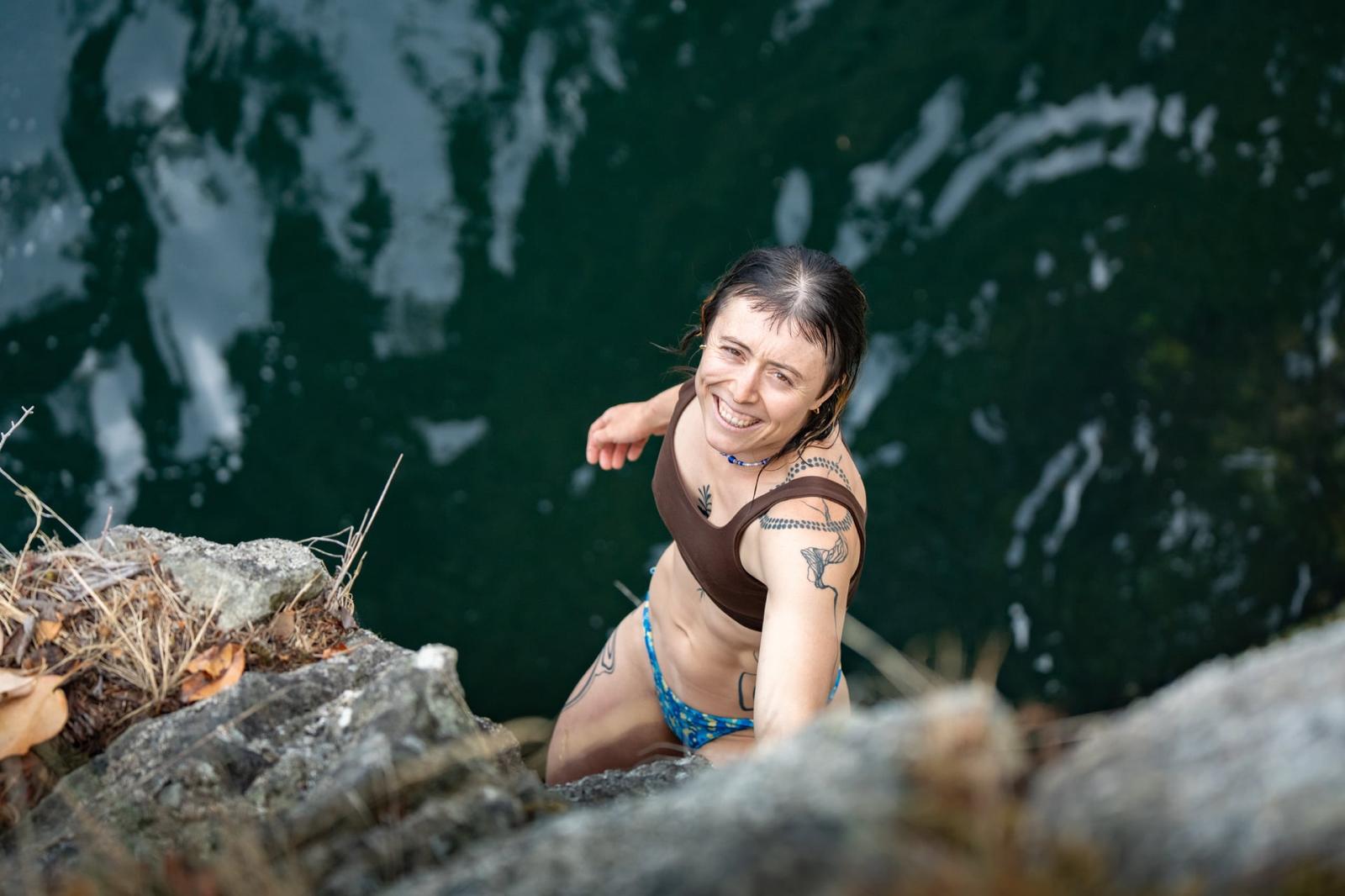
Amelia “Mila” La Haye is a 29-year-old mountain guide-in-training, climber, dancer, and longtime dirtbag who has spent the past decade building a life around curiosity, connection, and very little money.
At 19, she left Quebec for British Columbia with a hammock and climbing gear, and since then she’s lived in a car, joined a squat in Melbourne, studied dance, performed with a physical theater company, and traveled and worked her way around the world. (@m.i.l.a__s.o.l_)
Mila tells the story of dumpster diving and relying on strangers during a three-month, nearly zero-dollar bicycle trip across Europe with a friend, learning firsthand how much generosity exists when you simply ask. But that trip was just one chapter in a much bigger decade of experimentation: circus in California and Australia, workaways, vanlife, acroyoga, “trance dance” in Indonesia, Waldorf education, and eventually two years of adventure studies in Canada on the long road toward becoming an internationally certified mountain guide.
She has supported this lifestyle through seasonal jobs including tree planting, moving, gardening, wildfire work, and geotechnical fieldwork, often working only three or four months a year. She also has a financial cushion from childhood that gives her some psychological security, while keeping her expenses low and cultivating deep relationships has allowed her to live on remarkably little. Her recent geotechnical work even came through a chain of friends vouching for one another, illustrating just how much her life depends on community rather than conventional career ladders.
We talk about growing up in an adventurous family where treasure hunts, messy play, curiosity, and ridiculous family music videos were all part of normal life and how she found both the creative possibilities and cultural limitations of formal dance school. She also wrestles with the contradictions of working in the mining industry while caring deeply about the environment, and with the tension between her current “Mountain Mila” life of climbing and guide training and her desire for a home base, stability, and somewhere to keep her stuff.
Mila’s life is less a single grand adventure than a decade-long experiment in following curiosity, choosing connection, and repeatedly asking what makes her feel most alive. Her next chapter involves mountain-guide exams, ice climbing, skiing, another winter in Chile, and a 30th-birthday “celebration of life” in Squamish. The future remains pleasingly unclear.
Full transcript: dirtbagrich.com/mila
Recorded in September 2026.
Transcript
This is an AI-generated transcript. Typos and mistakes exist!
Blake Boles (00:00)
Amelia La Haye, welcome to Dirtbag Rich.
Amelia (00:03)
Hello.
Blake Boles (00:05)
at age nineteen you told me that you started living in a hammock and then a car, and you’ve pretty much never gone back from from this strange, wonderful dirtbag existence. Please tell me more.
Amelia (00:20)
This is true. I was just finishing up my Sejep, which in Quebec is like the two years that you do before university basically. So I was just finishing up my Sejep and I remember telling my teacher
Okay, before I maybe go into medicine or some kind of more serious thing, I’m gonna take a gap year. And she was like, that sounds like a great idea, as long as you go back to university after it. I was like, yeah, yeah, for sure. And I never really did do that. I left for the summer to BC with my hammock, some kitesurfing gear, some climbing gear, and I like.
was started living at the chief campground, but in my hammock, so then I would only sleep it I would put it up at night and then I’d take it down during the day and hide it away and stash it up to my friend’s tent so I could continue
Blake Boles (01:07)
And
Amelia (01:07)
living there.
Blake Boles (01:08)
and and just so everyone knows the chief campground is in Squamish, BC, British Columbia, which is where you are at this moment. Got it.
Amelia (01:15)
Mm-hmm, exactly.
So that’s kind of where it started. Although I’ve always had dreams of being a dirtbag. I was actually telling a friend this morning that when I was younger we used with my family, we used to drive by, you know, the places where they sell like a bunch of school buses and all the RVs. Have you ever seen those places?
Blake Boles (01:37)
Yeah, sure.
Amelia (01:38)
Uh-huh. I remember driving by those and saying, I really want to live in one of those, or, I hope I’d like to buy a bus one day. And there was always like a secret little girl fantasy.
Blake Boles (01:51)
And not long after that you went to Europe and decided to bike around for multiple months with no money at all, deliberately as as a choice?
Amelia (02:00)
Mm-hmm. I mean, that was although on a timeline it is not that long time ago, but I feel like there were so many different adventures between that time. Because after going after living in a hammock and being a little bit of a bum in Squamish, then I
drove my car down w down the west coast into all the way to California and then I was living in my tiny Toyota Matrix, like rolling out the bed at night and then rolling it back up in the morning so that I could fit my tote my like containers with all my food and all my gear and all my things. It was kind of a wild time. And then that brought me to Australia.
So like the Yeah.
Blake Boles (02:48)
Please explain how that brought you to Australia.
Amelia (02:50)
It brought me to Australia. because in California I started hanging out with a bunch of friends who are who were really into circus. And I got really excited about circus and performing and my friend in his front yard had like these rings and we used to swing on them and we used to play on they had like a bunch of monkey bars set up and we used to just like invent little routines and hang around there and
I got so much into it that I decided to go to this circus school camp thing in Australia, on in Western Australia, for a month. And that’s where I kind of fell in love with more both performing and with circus arts and all kinds of things. And then that led me so randomly to staying after the circus school and helping to film a movie.
So it’s just like wild life.
Blake Boles (03:47)
Okay. Go on.
Amelia (03:48)
I I think I’m so ready for any adventure and I didn’t really have many plans. So I would just say yes to a lot of things. I was like, wow, this sounds really like a good idea. Sure, I can do that. So I stayed another month and filmed a movie. And
Then I went to visit some friends in Thailand because my initial plan was always to go to Southeast Asia to backpack around because that’s what felt like true adventure to me, to my 19-year-old self. But I wanted to do something before. Like I wanted to like start my travels by doing some kind of course or some kind of thing that would help me meet people as well. So that’s why I decided to go to that circus school. So I went to Thailand.
met up with some friends, traveled a little bit around, did some work aways.
Met up with my family, which was lovely, and then had this realization that I didn’t really want to wander around anymore. I wanted to have a purpose. Like I wanted to feel like I was learning something or working towards something. And I was like, okay, well, what what makes me feel really passionate? And I really love dancing. Like I dancing makes me feel so good. And when I was in Australia at the circus school, I had met a friend who was studying dance in Melbourne, in Australia. So I thought,
Why don’t I just apply for that same school? And I don’t know how, miraculously I got in, because I have been dancing since I’m
Blake Boles (05:16)
What what kind of dance?
Amelia (05:18)
it was like a super commercial school. So it had ballet, jazz, hip hop, contemporary. And I say it’s amazing that I got in because like I have been dancing since I’m a tiny child, but very recreationally, you know, me in front of
in front of my parents or I’m dancing a lot with with Abba all the time. but never lessons. So I guess they I submitted one of my family music videos, which is another tangent to go on. Yeah,
Blake Boles (05:52)
We we’re gonna come back to that, yeah.
Amelia (05:53)
we’ll c we’ll come back to that. so I submitted one of those and I guess they liked my creativity. So I got into the school and moved to Australia.
Blake Boles (06:04)
Alright, you’re in the classic Quebec to BC to California to Western Australia to Southeast Asia pipeline. Many have done this before.
Amelia (06:11)
huh.
Blake Boles (06:14)
how old are you at at this point? Twenty, twenty-one? Twenty, twenty.
Amelia (06:16)
At this time I’m twenty. Uh-huh.
Blake Boles (06:20)
yes, we’re we’re getting to the biking around Europe with no money part.
Amelia (06:23)
Yes,
I was I was thinking, where was I going with this? But yeah. In cr chronological order.
Okay,
okay, Europe. So in Australia, I started going to the dance school. I tried to rent a house in a I no, I try, I tried to rent a room in a house. I slept there for one month and I thought, this is not for me, like
I can’t be paying rent. This is insane. Like this does not feel right. And I just felt like s such like a a black sheep. I was coming from Thailand wearing these like big, flowy, colorful pants, you know, just walking around slowly, appreciating life. And then everyone in the city was rushing around wearing black, like looking like they had a place to go. And it made me feel really, really different. And I made me feel like I wasn’t really belonging.
but thankfully there was the Acro Yoga community, which I found immediate friends in, and that was so lovely. And there I met a friend who introduced me to this squatting community in Melbourne, called Crunchy Town, which is now a worldwide international community. I don’t know how many of us we are, but there have been so many travelers who have gone through this squat in Melbourne, which no longer exists, but the community lives on.
within friend groups and sometimes they have gatherings in different places around the world. So it’s pretty insane.
But I met a friend through acro that brought me to the squat, and there I started living there, and then I was living this dual life where I was going to dance school during the day, and then I would get home and then go and like dumpster dive, because that’s how we would feed ourselves. Then we would have to go and collect water, because there’s no running water.
And there was all these like different missions to keep the squat running. And I’d do that with my friends until super late. And then the next morning get up super early and go to dance school where it was just such a contrast of different lives and values.
Blake Boles (08:31)
Did any of the other dancers at the dance school know that you were living in a squat and dumpster diving and probably living off of very little money?
Amelia (08:39)
I think there was one person that was kind of curious, but other people were very mainstream. And I really struggled with the school, honestly. I thought that it was gonna be a great welcoming community, but it felt really clicky and husl and especially not coming from a full dance background, I felt like I was this like again, this weird colored rainbow colored sheep coming in and loving dance but not really liking to follow all the steps all the time.
Blake Boles (09:07)
Hm.
Amelia (09:09)
So no, it I don’t think a lot of people knew.
Blake Boles (09:12)
What happened next? We’re not in Europe yet.
Amelia (09:14)
No, we’re not in Europe yet. It’s a little while. Then I decided that I really did not want to keep living this like double life. So I stopped going to dance school because I felt that living the squat and acro yoga and friend
was more friend life was more what I wanted to be doing at that moment. So I stopped going to dance school, bought a van, started doing workaways, on the coast of Australia, sometimes going to volunteered festivals. Basically, like
living a very free, wanderless time. And during that travels, we’re getting to Europe, we’re getting to Europe. During that those travels, one day I was dancing at a drum circle in Byron Bay, super classic and very cliche, and met this
Blake Boles (10:04)
Absolutely.
Amelia (10:05)
yes, super cliche. It’s almost like a movie. And I remember looking over and seeing this other girl by herself and
It is as rare, maybe less so now, but it was really rare for me at the time to see other women traveling alone. And I remember seeing her and we locked eyes and we were both like, aha, kindred kindred spirit, like so such a great meeting. And we immediately afterwards started chatting.
And within two days of knowing each other, we had to had talked about travels, about our life. She was actually going down to Melbourne to go live in the squat because she had heard about it from the same friend that I had met in Melbourne too, which
Blake Boles (10:47)
Hm.
Amelia (10:47)
and we hadn’t known each other, so it was just super serendipitous.
Blake Boles (10:49)
Well.
Amelia (10:51)
And and super meant to be. And during those two days, we made up a plan that we were going to live with no money.
for a certain amount of time and travel around Europe and do a bike trip. There were so many things we wanted to do, and we just couldn’t we just put it all into one expedition or one plan. And we were gonna do that together. And that I idea originated from the fact that people would always ask us, how have you been how have you been traveling for so long?
Like, how are you doing it with money? And we were like, I think we can do this to a more extreme level and we can like experiment for ourselves. What is it like to really do with we’re like travel with no money? Because we had been she had been traveling for a long time. She actually had just sailed, helped helping out on a crew boat from New Zealand to Australia.
And we both had dumpster dived a lot and just like lived in such a way that we were like, no, you can totally travel with really, really low budget and we decided to try this ex social experiment of really going zero dollars.
Blake Boles (12:07)
I love this for the record.
Amelia (12:08)
Mm-hmm.
Blake Boles (12:10)
as you continue in the story, I’m curious how you navigated something like like airplane tickets, for example. I unless you you both volunteered on a boat to to get there. But even Australia to Thailand, California to
Amelia (12:23)
Mm-hmm.
Blake Boles (12:23)
Australia, Australia to Europe. that’s a it’s a hard one to to get around.
Amelia (12:29)
Those that is completely true. So we did decide that we were gonna do a certain amount of time and like airplane the airplane tickets since then I had been saving since I was a young kid. Like I was always one to get birthday money, bank, put it in the bank. I get a little bit of like do a bit of gardening at the neighbors, put it in the bank. Like never buy anything really. So I had quite a bit saved up from that.
So that’s how I had been traveling since that since before that. And then we decided to do the bike trip one year later. So we made this commitment that we both had separate plans during that time, but we were going to make it work. We were gonna meet April in the next year in Berlin, and from there we were gonna source bikes and we were gonna start our trip.
Blake Boles (13:19)
I love that you use the phrase do some time, as if you’re gonna go like be in prison for a while in order to to earn your passage to the next continent.
Amelia (13:31)
do you want me to continue with the story? Okay,
Blake Boles (13:32)
Yeah. I’m I’m loving this. Please just continue.
Amelia (13:35)
okay, so a year well, kind of fast forward a year later. In that year I met my now ex-partner who was kind of the main reason why fast forward five years later I was gonna live five years in Australia, which is another whole chapter, but coming back rewind, coming back to
Byron Bay met this girl, we decided we were gonna do this trip. Her name’s Jerry. We were gonna do this trip together. So then we created an Instagram, we started reaching out to sponsors, European sponsors, Canadian sponsors. We got a few things. We got some nice snazzy bike outfits, some like water holders, and most importantly, we got some really nice bike bags, so that felt like a big motivation of okay, we’re actually doing this. We
I so a year later we met in Berlin
We are staying thankfully at a friend’s house. So I feel like it’s really important for me to mention that I live this very f frugal lifestyle, but I also am so grateful for the friends around me and for the community around me because I feel that that’s how mainly it’s possible. Like even right now, I’m I don’t have a stable home and I’m staying in a friend’s house so that I can record this and have a like reliable internet signal and good set.
So you know these tiny little things.
Blake Boles (15:04)
I’m also
staying at a friend’s house right now so I can record this. you’re in good company.
Amelia (15:10)
Uh-huh. So just want to say that nothing is possible without the friends and the community that I’ve made along the way.
so we were staying in Berlin. We managed to make friends at a bike shop, and he had this really old bike in the basement, and we we would always come in being like, Hi, we are doing a social experiment. And I th and I feel that years ago I could do this speech so well because we’ve done it so well, but I haven’t done it in years. But we we would always we would always come in like
Blake Boles (15:38)
I’m ready. I’m ready. Act like I’m the Berlin
bike shop
Amelia (15:41)
okay.
Blake Boles (15:42)
bro, yeah.
Amelia (15:42)
Well, a lot of people call me Mila. So we’re like, Hi, we’re Milan G. We’re doing a social experiment where we’re trying to live with no money and we’re doing a bike trip. Would you have anything that you’d like to trade or exchange? And then if we were in restaurants, we’d say, like, we could maybe do your dishes or mop your floors in exchange for food, or we could post on our social media, and we could write you a song. And this bike shop person in Berlin thought our idea was great and gave us an old bike.
in the basement that he had found and fixed it up for us and we put our pan years on that and that worked for one. And then the other bike
This is like we had struggles along the way for sure. This other bike we had to buy off Marketplace really cheaply, but it did feel a little bit like, are we cheating? Like it’s only a week in and we’re already cheating. no, this is bad. But it also felt like, okay, we kinda wanna get our show on the road. Like we had been in Berlin living at this friend’s house for a while and we were like, we need a bike to get the trip started. So let’s just get this cheap marketplace bike, put our panties on and head out so that we can actually start the journey.
instead of it being a whole story about how we sourced a bike in three months in Berlin to be able to leave afterwards.
Blake Boles (16:57)
Yeah, less glorious.
Amelia (16:59)
Yeah, exactly. So and we were also excited to like we had itchy feet to go and explore and see what what the world would bring to us.
Blake Boles (17:08)
Where did you go? Which direction? North, south, east, west?
Amelia (17:10)
We went north
because we both had this odd drive to go to Copenhagen. It was so random. We were both like, let’s go to Copenhagen, like just like fixated on it. So we went north and we started biking and she had done a bike trip in New Zealand the year before. And I have done I had done a bike trip with my mother when I was younger.
But I had never really done a bike trip, so we just went off super enthusiastically and did a lot of kilometers and got pretty tired, but it was so fun. And for food we would dumpster dive. So that adds an extra challenge because we couldn’t really choose what we were eating. We also couldn’t really know when was gonna be the next dumpster. So every time we would pass a town we would always stop
And look in the dumpsters, we ate a lot of bananas. There was so much many fruits and so much bread.
Blake Boles (18:15)
Would you just go behind bakeries and grocery stores?
Amelia (18:17)
Yep, exactly.
Blake Boles (18:18)
Simple.
Amelia (18:19)
Yep, super simple. and but also we discovered that depending on countries, they have different waste management systems. So Germany was super easy because a lot of their dumpsters are open. But then when we got to the Netherlands, a lot of their dumpsters are like behind these grates, almost like a parking lot behind the behind the store, and it was really hard to access.
So we all we learned that and then Denmark was awesome because they have a lot of food share like ways already set.
So we started doing that. And then for sleeping we would often sleep most of the time we would sleep in our tent. But we also used warm showers. Do you know about that? Yeah.
Blake Boles (19:06)
yeah. And I’ve talked
about that with other guests. But it’s like couch surfing for cyclists.
Amelia (19:10)
Uh-huh. And it’s great because you first of all you already have like a common point, which is biking. But oftentimes the worm the worm showers person also knows that you probably want a really good big meal. You’re gonna eat way more than the normal person. like if you’re you’re probably gonna go to bed
non s not socially acceptably early, like, you know, eat and then pass out because you’re really tired. And you’re probably also gonna wanna see buy pictures of their trips and so it’s that was really nice to connect with other cyclists along the way.
Blake Boles (19:45)
So, I just want to make sure we have time to get into other parts of your life too, Mila. Maybe you can
Amelia (19:51)
Uh-huh.
Blake Boles (19:52)
you can tell me how long did you live in in this phase of your life? Just going from like one kind of a spontaneous adventure, travel adventure to another, living on very little money, or are you still in that mode? Do you feel like like
That this is just a continuous string that has led you to today.
Amelia (20:17)
Oof that’s I think I’m somewhere in the middle. I think that now I plan a little bit more but my lifestyle is very still very quite similar. I I we did that although I’m s I’m not in the no money
experiment anymore. We did that for three months and then let go of that experiment and it was great and we learnt so much about human kindness and generosity and what is giving and what is receiving and taking and like we had a lot of great philosophical discussions about that. but now no, I live a
a money using lifestyle, but still very adventurous and still like one from the outside might say a little bit random, like always a little bit jumping from one idea to the other, like one project to the other.
Blake Boles (21:17)
give us a whirlwind tour of age twenty, finishing up the the three months no money European biking tour to today, age twenty nine. At at the moment you’re back in British Columbia, but I I know that that will be changing. just the the the sweeping overview, please, and then we can go back and dive into specific parts of that.
Amelia (21:39)
Okay, sweeping overview. Don’t let me get too wormholed in one thing.
Blake Boles (21:43)
I’ll do my best.
Amelia (21:44)
Okay, great. I seem to like to go somewhere different. well, finished that, traveled a little bit in Europe. Then I, like I had said, I said before, I had met my partner, so we moved back to Australia together. There I studied Waldorf or Steiner Education.
For I I lived there for five years. So I studied Waldorf education. Then I studied massage. Then I well, I was there during COVID, so that was a big chapter. Then we both decided to move back here. I decided to go to it’s a program in Kamloops at the at Thompson Rivers University, and it’s the Adventure Studies. So I did like two years there basically to become a guide. and then
Then since then has kind of been my adventure chapter. Like I have been rock climbing so much.
Blake Boles (22:44)
Since
since then has been your adventure chapter. Okay. Ma maybe i
Amelia (22:46)
Well yeah, actually maybe I should rephrase that, but
Blake Boles (22:49)
in contrast to being in a formal education program for two years and living in Australia during COVID, perhaps. But I just had to point out the the deep irony of
Amelia (22:58)
That’s true.
Blake Boles (22:59)
you saying that.
Amelia (23:00)
That’s true. Maybe I think that it’s been like my intense mountain rock climbing era since then.
Blake Boles (23:06)
There we go.
Amelia (23:07)
Yeah, I think I’ll I’ll we’ll rephrase that because I have been living adventurous life for a long time. But that is the start of like I like to call this chapter Mountain Mila. So and the other one the
Blake Boles (23:18)
Ha ha ha.
Amelia (23:20)
other one was Australian Mila. So although my name I’m just gonna say, although my name is Amelia, a lot of people know me as Mila.
and so then the mountain Milla chapter started and then two years ago I went to Chile and now I’m in my Latin American Milla phase. Yeah,
Blake Boles (23:39)
Latin American Mila Adventure Face.
Amelia (23:42)
which is overlapping with the rock climbing, but very much it’s like all different little chapters.
Blake Boles (23:49)
Great. Let’s we’re gonna dive back into some of those specifics, but I I really appreciate just the the narrative to give us a a base there. and I I want to talk about some big picture stuff. And so I think when a lot of us hear s beautiful stories like this or see photos from these kinds of adventures online, you know, the first place we go is how do they have time to do that? How do they have money to do that?
And you’ve done a great job of explaining how you’ve been able to spend very little money and you’ve you got involved with people who do squatting and and dumpster diving
Amelia (24:26)
Mm-hmm.
Blake Boles (24:26)
and you camp a lot and yeah, you you’re obviously good at at finding and creating these kinds you you’ll ask a bike shop if you can do something for them and you get a free bike in exchange.
Amelia (24:38)
Uh-huh.
Blake Boles (24:39)
what about the other side of the equation? That you mentioned that you you worked and you saved a lot as as a child, and so you were you had some savings to use
But still at at at some point throughout these journeys you you need to earn a bit more money, I assume. So can you just tell me how you were how you were doing that over the past decade?
Amelia (24:58)
Mm-hmm. I’ve always done a bunch of random different things. I have tree planted, which is super lucrative and you make a lot of money in a really short amount of time. And when I was living in Australia, I worked for a moving company, and I did that pretty consistently. so Australia I feel like was a little bit more of a quote normal lifestyle.
because I had a more steady job. so I worked for a moving company, I worked for a garden, then coming back here, also worked coming back into Canada, I also worked for Forest Fires, recently worked as a geotech up north. so mm
Blake Boles (25:43)
sorry, when you
say you worked for forest fires, do you mean wildlife fire management? Okay. And
Amelia (25:47)
Yeah, exactly. Yeah. Yeah.
Blake Boles (25:49)
Geotech, for those of us who don’t know, what is that?
Amelia (25:52)
It’s a geotechnician, so recently we were trying to measure the density of the soil to see if there was any minerals in the soil.
Blake Boles (26:02)
Okay. And and y you mentioned that you never did like a regular undergraduate program. Is geotech something you can do with like get on the job training or I’m just curious.
Amelia (26:12)
Yes,
I just appeared and the day one my friend said, you’re a geotech. Did you study geotech? And I said, This is day one. I have no idea what I’m doing here. Like
Blake Boles (26:23)
Ha ha.
Amelia (26:24)
I was like, I I do not know at all what we’re coming to do here. And through friends.
Blake Boles (26:28)
Well, how did you how did you get that job? I I think there’s so many young people who are who
are just struggling to be like, How do I get my foot in literally a the door of any interesting job? So w what did friends look like? How did someone refer you and say, Well, Mila has no experience but you should still hire her?
Amelia (26:43)
I think this is a friend that I did a big expedition with last year that knows me quite well, and he also is not a geotech, but got in through another friend who’s not a geotech. Like it’s just knowing people, I think, and just this world
Blake Boles (26:55)
Yeah.
Amelia (26:58)
of contacts and community.
Blake Boles (27:01)
It it’s funny, like I I believe you and I’ve I’ve had similar experiences. Maybe not entering a a whole new field without any relevant experience like like you seem to have. But it’s not just knowing people, right? The kind of networking that you’re talking about. If you went on a big expedition with this
Amelia (27:17)
Uh-huh.
Blake Boles (27:17)
friend, like this person knows you in a way that is is deep and intimate and like can really vouch for you in these you know, ’cause he’s
probably seen you in these high risk situations, high stress, l
Amelia (27:31)
Yes.
Blake Boles (27:32)
low sleep. and so yeah, to me, it’s it’s not just about knowing people. It’s about like having gone through like real challenging circumstances with people. And then when those people vouch for you, they’re not just like, this person’s nice. I give them a job reference. But it’s like, stop, sit down, let me tell you about Mila. And
Amelia (27:52)
Uh-huh.
Blake Boles (27:53)
then that is like this like next level referral. And
I just ha have the feeling that that’s something important to emphasize when we talk about like how do you get into these cool jobs without formal qualifications or without going through the front door. ’cause the HR department might have just like screened you out immediately, right?
Amelia (28:12)
That’s true. So having really good friends and making Yeah, because they’re not just like connections that are gonna give you a small recommendation. It’s like someone who, as you say, will really vouch and say like they can go through hard things. Cause I think for this job what was required was that you could like tough the elements and really show
Blake Boles (28:32)
Hm.
Amelia (28:32)
up and h and work hard. And I think that’s something that I do throughout my whole life is like
Blake Boles (28:36)
Yeah.
Amelia (28:37)
give it my hundred and twenty percent. Like I’m always like
s and super excited about life. Like I’m like stoked. Like I’m like, ooh, what are we gonna do next? Or super proactive. So I feel like that well, my friend in this case knows me in those s in that setting and could really
Blake Boles (28:54)
Yeah.
Amelia (28:54)
speak for that.
Blake Boles (28:56)
And it sounds like a lot of the jobs, or even most of the jobs, were very physical jobs.
Amelia (29:00)
Yes.
Blake Boles (29:01)
Tree planting. That sounds physically difficult.
Amelia (29:04)
my god. The hardest job I’ve ever done for sure. Yeah.
Blake Boles (29:09)
Okay, so a lot of seasonal jobs, and have you been able to fulfill this like dirtbag rich ideal of being able to make a good amount of money in a short amount of time while also not feeling like your job is terrible and you hate yourself or you’re hurting the world after you do it?
Amelia (29:29)
yes but yeah or yes and there’s also another component in there that you and I Blake spoke a little bit briefly about before was that when I was younger, something happened that I don’t really want to mention, but it made that I had that I have right now a certain amount of money. So it does feel like I have a cushion that
is not something I I use like about five thousand dollars of maybe a little bit more a year and I’ve used it in the past to like buy a car to like kind of set myself up here so here I live in my van so to buy my I live in this tiny van to live to buy this van but I don’t really use it that much but psychologically I think it does something to me that like
I feel abundant because I feel that okay, if ever something big were to happen, like I would be okay.
Blake Boles (30:28)
big like medical disaster, that kind of big
Amelia (30:33)
I mean, hopefully insurance will cover that because I don’t think I could I don’t think I could
Blake Boles (30:37)
Yeah, yeah.
Amelia (30:38)
cover that big, but like I don’t know, if I it’s this like little mental piece that I can feel safe with being like, okay, if
If for a whole year I feel like I need to rent a room in a house and I need to take care of myself in this way, I could probably do it, but I couldn’t do it forever. So it’s also this thing of like, okay, there’s this like tiny reserve of money that is there that I can sit on, but it’s not gonna be there forever if I keep using it. So I never use it. And then it and then it just sits there.
Blake Boles (31:18)
And I remember when you mentioned this to me, I thought, does
Amelia (31:21)
Uh-huh.
Blake Boles (31:22)
she have a a a trust fund? And and then you told me a l a little bit more than I and I said, Wait a sec, so if you take out five thousand dollars on an average year from this this fund you got b from the thing that happened to you when you were a young child, how much more money are you bringing in through employment? And I think you told me your average income in recent years has been about twelve thousand dollars.
Dollars Canadian, is that right?
Amelia (31:49)
Yeah, about something like that. Sometimes, yeah.
Blake Boles (31:50)
Yeah.
which I said, excuse me, this is still a an incredible accomplishment. The kind of life that you seem to be leading, and you’re doing this on ten thousand dollars, more or less, even if it was double that, even if it was twenty thousand dollars. Let there are people out there who just scratch their heads and say, How is this how is this even possible? And and honestly
If you’re if you’re working to earn, I don’t know, seven thousand dollars a a year, I I imagine that that going from from that up to like a bit more, you know, whatever the amount is that that you r receive from your your your fund, would not be a huge leap either.
Amelia (32:38)
Mm-hmm. No, you’re totally right.
Blake Boles (32:41)
So I I’m glad that you you, you know, are open about this and I also feel like it does not change the magic of your accomplishments in any significant way. Although it it seems like the psychological benefit to you is pretty profound. This feeling of like you have a cushion.
Amelia (32:57)
I think. Mm-hmm.
It’s something that it’s I’ve r I’ve have felt a lot of my life like a guilt and a shame because a lot of people around me live are like working really hard to to have this well, I guess we’re all working the same way, but
I always felt like a little bit different, like I was this like fake dirt bag or I wasn’t really scraping it because I could really buy that for myself.
Although if I use it then if I use it all then it won’t be gone. If if I keep making decisions, let’s say every day I want to eat salmon, if I start doing that, there’s gonna be no more of that money. So I have I ha there’s this
Blake Boles (33:38)
Ha ha ha.
Amelia (33:39)
part of me that okay, I need to really make good decisions so I can keep living this lifestyle. And like I said, I I used to be like really ashamed and then it’s only a year ago that I’ve actually started telling people. And it’s been nice to have a lot of people tell me, like, good for you instead of being angry and jealous and which is the
the thing that I had feared. So that has been a process for me to just, you know what, this is instead of lying and saying something, it’s like, you know what, this is how I this is something that I have and it’s there and it’s not really my fault. It just happened to me and this is it.
Blake Boles (34:17)
What I find so interesting about your situation is that whatever amount of money you’re you’re talking about here, I’m sure there’s a lot of people out there who have that amount of money. Maybe it’s tied up in a in a house or something else that’s not quite liquid, but I think there’s a lot of people out there who have access to this money that gives you such psychological comfort and empowers you to do all these other things with your life. But the fact that you
seem to be so good at connecting with people and also keeping your expenses very low is really the the magic. It’s really what is enabling it’s not the money, right? It’s it’s
Amelia (34:57)
Mm-hmm.
Blake Boles (34:57)
all these other things that that are enabling you to lead this life of what other people perceive as very high v freedom, high adventure. Mila does what Mila wants.
Amelia (35:09)
Uhhuh, hundred percent. That does sum it up. Yeah.
Blake Boles (35:14)
Yeah, super interesting. Let’s talk a little bit more about what Mila does and and what Mila wants. let’s go back to the beginning here because we haven’t heard about your your family and our mutual friend Kelsey, who connected us. Shout out, Kelsey. mentioned
Amelia (35:27)
huh. huh.
Blake Boles (35:28)
that you have a very like cool family and kind of a silly family, and you mentioned that you guys make music videos together. so tell tell
Amelia (35:36)
We do.
Blake Boles (35:37)
me a bit more about your early life.
Amelia (35:40)
My family is awesome. I love them so much. I’m gonna plug my brother here. My brother right now is biking. He started in Banff in Canada and he’s now on the he’s like close to the border between Ecuador and Peru right now and he’s biking the whole way until Patagonia.
And through Central America he was they were towing surfboards, which is kind of insane. And yeah, you can check them out. I’m plugging my brother, Rolling Tides on Instagram.
Blake Boles (36:13)
Rolling tides
got it.
Amelia (36:14)
Uh-huh,
uhhuh. Really cool person. So just saying that like the adventure is for sure in our genes. And I was recently at my parents’ place and you know, a lot of people ask my parents, you know, why are you are you sad that your kids are not home? And you know, how ha what ha what did you do to make your kids so adventurous? And my mum reflects back on the fridge magnets that we have and they said like, follow your dreams. like live confidently or like
These sayings that really promoted like agency, doing what you wanted, going out into the world. So maybe it’s the it’s the fault of the fridge magnet’s fault. Yeah. Yeah. And
Blake Boles (36:53)
The fridge magnets come on, come on.
Amelia (36:57)
one of her friends said she’s gonna make a fridge magnet that says buy the house next door. I thought that was great. That’s certainly one we did not have.
Blake Boles (37:06)
Well, were your parents adventurous?
Amelia (37:08)
my parents were super adventurous, yeah.
They also went traveling when they were younger in I guess the nineties, when traveling backpacking around was a little bit less common before they had my brother and I. They went to work in the USA and had my brother and I there, which I kind of see it as the equivalent today of like, I don’t know,
going to Europe on a work visa to do a little stint of money before coming back or something. So they were doing things out of the norm for sure. And they have always supported us in doing whatever we want and making us they would all they I know that they’re super proud of us with what we’re doing. And that doesn’t have to look like normal schooling.
Blake Boles (37:57)
Sounds like you did go to normal school, but then when you chose not to go to univers university and to go start your your dirtbag adventure life, were they totally supportive of your choices?
Amelia (38:08)
They were super supportive, yeah. Hundred percent Mm, I
Blake Boles (38:10)
Yeah, that’s super rare. Yeah.
Amelia (38:13)
feel super grateful. Yeah.
Blake Boles (38:17)
And so it was your mom, your dad, your brother and
Amelia (38:21)
Uh-oh.
Blake Boles (38:21)
yourself and did you grow up in like a normal house? Did you do like normal kids stuff? I’m just trying to to mine any
Amelia (38:27)
Ha ha. Uh-huh.
Blake Boles (38:29)
other like unique early influences on you, Mila.
Amelia (38:34)
We did semi normal kid things. At some point I went to an alternative school. Tristan and I, my brother, we were homeschooled both for half a year at different times because that’s what we wanted. Like I remember deciding in grade three, like, okay parents, I think I want to be homeschooled. And they both work for themselves, so they have the flexibil they had the flexibility to say, okay, and one of us would teach me while the other one would work.
And they would alternate like that. And then they did the same thing for my brother for half a year. And so that was a little like different schooling that we had. But we always I think we’re really encouraged to follow what we were curious about. And
Recently my mother also we were reflecting on the fact that she s said that a lot of things we would do, she would frame it as an adventure. Like, we’re going on an adventure to the local river to find something. Or like there was we always had treasure hunts, that was like a big thing. So there’s always like a lot of mystery, creativity, curiosity fostered in our household.
And a lot of play. Like, we had messy play days where we would just like mix water and flour and put it in our hair, or cornstarch and water and touch how it feels, and like a lot of hands-on explorative things. Uh-huh.
Blake Boles (39:54)
Yeah, yeah, very tactile. Tell me about the music videos.
Amelia (39:59)
at our house we must have like 20 wigs. We have so many wigs and
It started when we went on a family trip once. I thought, why don’t we make a video? And then just hasn’t stopped. Like
a recent one my brother made was a silly one about being grateful about things and we would just lip dub music videos and wear different wigs and either walk around this like we did one in Costa Rica when we went there as a family we’d just like walk around Costa Rica and take f film like choreograph dance moves and just film that. And yeah, it’s just ridiculous, but it’s awesome.
Blake Boles (40:41)
Out of curiosity, what did your mom and dad do for for their self employment when you were growing up?
Amelia (40:46)
Uh-huh.
My dad is a physio and he still works for himself. So physiotherapist, yeah.
Blake Boles (40:49)
Physiotherapist? Yeah.
Amelia (40:52)
I think in the US it’s called physical therapist, no? Yeah. And he they both have a clinic in like the basement of our house. We live in like a smaller country town near Montreal. And so my dad works as a physiotherapist and my mom works as an occupational therapist. But right now she’s finishing her PhD. So she yeah.
Blake Boles (41:13)
That says
something right there. what she’s studying.
Amelia (41:15)
Uhhuh. Uhhuh.
occupational therapy. She’s doing a a
Blake Boles (41:20)
okay.
Amelia (41:20)
PhD on play. It’s awesome. Uhhuh.
Blake Boles (41:23)
my gosh. This
all this all adds up.
Amelia (41:26)
That’s it.
Blake Boles (41:27)
did you did you feel different growing up? Did you feel like the like treasure hunts and the wigs and the I wanna homeschool? All right, we’ll homeschool you for half a year. Like did did you feel like you were living a different kind of life being being raised outside of Montreal th than other kids around you?
Amelia (41:47)
I think so. I think maybe I was not objectively different, but I really liked to be different. Like it was a pride that I took.
Blake Boles (41:54)
Hmm. That was celebrated.
Amelia (41:57)
Yeah, it was celebrated to be different and original and yeah.
Blake Boles (42:03)
Great. That’s helpful. let’s fast forward to Australia, ’cause I don’t want to miss talking about circus school and your your dance era.
Amelia (42:11)
Uh-huh.
Blake Boles (42:13)
And and you spent five years there, so that’s a that’s a big chunk of your twenties.
Amelia (42:16)
It is a wild time. That feels like a different life. Like looking at me now and looking at Australia, I was like, is that really me? interesting. Okay, I did that too.
Blake Boles (42:27)
Well
yeah, which version of you was that in Australia?
Amelia (42:30)
That was like community artist villa.
Blake Boles (42:35)
What kind of art?
Amelia (42:37)
I was part of a physical theater company.
Blake Boles (42:40)
Which means clowning for the rest of us.
Amelia (42:42)
kind of, yeah. Well, I don’t know if the people of the the company would agree, but and you
Blake Boles (42:49)
Okay.
Amelia (42:49)
know what you were saying earlier about things that like jobs that you just kinda get roped into that you don’t have any qualifications
Blake Boles (42:56)
Sure.
Amelia (42:56)
for. Well that kinda was one. I
All the other people of the company were trained actors that had actually been to acting school and I just came out of nowhere as like a climber performer human and was part of the company with them. Uh-huh. And that was one of the funnest things I think that I was doing in Melbourne for sure.
Blake Boles (43:22)
What about dance? How did dance fit into this life?
Amelia (43:27)
Well, dance is as I was explaining before, like the thing that brought me to Melbourne in the first place.
Blake Boles (43:32)
Yeah.
Amelia (43:33)
And then with my ex partner, we were performing a lot, or we would dance multiple times a week, mostly like a static and free form dance, and then this other form of like trance dance and then we s performed in Malaysia and India and it was like now that I look back on it, I was like, What were we doing? That was so funny. But we danced a lot. Yeah.
Blake Boles (43:51)
Ca can you just spell that out a little bit more for me? You were performing
d trance dances, we’re talking trance like like techno music? Are we talking trance like
Amelia (44:00)
No.
Blake Boles (44:01)
entranced?
Amelia (44:02)
Entranced, yes. I’m not sure I could fully explain it. Honestly, I kind of got thrown into this community. I was like,
Blake Boles (44:09)
You were doing it.
Amelia (44:10)
I was doing it, I think. I think no one could
Blake Boles (44:13)
Think
Amelia (44:13)
really explain what we were doing, but we were all doing it. And we were all there
Blake Boles (44:16)
Ha ha ha.
Amelia (44:17)
to experiment together and to like figure it out together.
The main teacher of this he was doing his PhD or his master’s, I’m not remember. Apologies to him. That about trans dance and focusing which has a root in Indonesia and we were working with Shaman there and Yes, it was very v I was just thrown into the myths of this and trying to understand it, but doing it, you know.
Blake Boles (44:43)
Sounds like you were in a trance for this period. You don’t even remember what ha what happened, but you know that you did it. There’s photographs, I guess I was there.
Amelia (44:47)
Yeah, potentially. Yeah,
I was there.
Blake Boles (44:53)
let’s fast forward a little bit more again because you also mentioned that the past two winters you’ve lived in in Chile. You basically became fluent in Spanish and you’re
Amelia (45:03)
Mm-hmm.
Blake Boles (45:03)
training to become a mountain guide. What what’s the the acronym of the the training organization again?
Amelia (45:09)
The IFMGA mountain guide, which is like a international certificate that started in Switzerland, but you you’re like a mountain guide, which means that you can work all around the world in the mountains. Guiding, skiing, ice climbing,
Blake Boles (45:24)
Yeah.
Amelia (45:25)
rock climbing, expeditions, adventures. Uh-huh.
Blake Boles (45:28)
Yeah, that’s right, ’cause when
you and I met recently you told me that you’re trying to to do a lot of ice climbing this winter. Yeah.
Amelia (45:35)
Uh-huh, that’s I’m shifting
my focus from climbing a lot. When I say a lot, a lot, to trying to ice climb and ski more. Uh-huh.
Blake Boles (45:44)
Got it. Okay.
How did you get roped into to this? How d how did this fall into your
Amelia (45:49)
Ha ha
Blake Boles (45:49)
lap or or you manifested this?
Amelia (45:52)
Uh-huh. The guiding course or the IFMG. Okay.
Blake Boles (45:54)
Yeah, the guiding. And being in Chile.
Amelia (45:56)
Well, I did that two years in Camloops, so at the university there at TRU. And that was like I was like pre-guide school because
It wasn’t actually the exams because okay, first of all, the IFMGA you can get certified in different countries. So there is a certification that’s given in the US or in Canada. And it’s a series of I think I want to say like seven different exams. And on top of that, there’s other certifications you need to get. So it can be quite a lengthy process. Some people very rapidly can do it in four, but most people will take
six, seven, eight, sometimes ten, twelve years to actually finish this thing. So it’s a huge process. And it kind of feels almost like a PhD of mountain guiding. because on top of doing exams, you have to train, you have to do prerequisites, you have to do practicums,
So it’s always something that I thought, this could be really awesome to do, especially when I was in the program. I thought, okay, I’m going for it a hundred percent. I think one thing that drives me is in Canada, I might get the numbers wrong, but there’s about 200 plus mountain guides, like full mountain guides we call them. And I think there’s like 10 or 12 women. Maybe there’s more since I looked into it last time, but
Blake Boles (47:16)
Mm.
Amelia (47:17)
a part of me is like feels like, we need more representation in this world. So that for sure fires me.
Also, I feel fired by my love of the mountains and teaching and being in the out great outdoors for sure.
Blake Boles (47:33)
Yeah.
Amelia (47:34)
so I th thought, maybe I’ll do them in Canada. And I was going to apply for the you I I would start with like Apprentice Rock. So that’s like kind of the first one that I was gonna start with. But before I applied, I went to Chile with my climbing partner Ethan.
a really good friend of mine and we went to Chile and Argentina on like a Patagonia climbing trip. And I realized that I could do the training there. So that’s what I started last year.
Blake Boles (48:07)
Okay. in recent years, how much do you think you’ve been working for for money compared to doing stuff not for for financial reasons? I I hesitate to say, you know, having free time, ’cause it sounds like you just love doing all sorts of stuff all the time. You move from one cool thing to the next. And it might be hard to to know when you’re working and when you’re not working, but
But maybe give give me a sense of like how much you perceive yourself to be working for money throughout an average year in recent years.
Amelia (48:43)
I feel like I work very little. Very, very little.
Blake Boles (48:45)
Yeah, what does that mean?
Amelia (48:47)
Like on a number I must work like three, four months of the year. I also Yeah.
Blake Boles (48:53)
Great. So quarter time, third time. Yeah.
Amelia (48:57)
Yeah. I also recently, two years ago, started my own business. So that doesn’t really bring me a lot of money, but it is something that kind of just is nice money rolling in sometimes.
Blake Boles (49:12)
Tell me, tell me what is this business?
Amelia (49:13)
Uh-huh.
This small business is called I invented a conversation card game called Deep Roots and it’s to help people connect more and have more vulnerable and authentic conversations because I myself don’t really like small talk and I like asking sometimes deep questions and sometimes I had noticed that people sometimes would have a hard time asking those questions off the bat, so I’ve reframed it around a card game.
Blake Boles (49:44)
Well, in the spirit of that card game, Mila, like what do you
Amelia (49:48)
Yes.
Blake Boles (49:49)
what do you think the connection is between all these different things that you’ve done with your life in the past decade, give or take? Like the purpose, the the meaning behind it. Are are you are you thrill seeking? Are you a connection junkie? Do you just someone tells you about something cool and you’re like, I have to go really deep into that? And then you move on to the
to another thing. So you’re like an explorer of different subcultures. Can have you thought about this? And if so, what’s your your best guess at this moment?
Amelia (50:23)
I think connection is super important. And I think curiosity is a big link too. You know, just over the past hour I think I’ve described my life many times as different chapters. And
I kind of follows the thread that of things that make me feel alive. So in Australia, I was really following the dance and the performance, and that was really what I was following. And now I feel like I’m following this adventure. And now this like curiosity of learning a new language, of learning a new culture, and just really checking in with myself of is this does does this feel right right now? Is this bringing me a lot of joy?
Do are the connections nourishing me? Do my feel do I feel like I belong? Am I bringing joy to the world around me? And okay, this feels right then. Let’s keep going with that. Uh-huh.
Blake Boles (51:20)
And when people ask you, as they sometimes ask me, like, Wow, you seem to move around a lot and do lots of different stuff, do you ever get tired or burnt out or just wanna stop and be in one place and have a home base and have some stability and repetition and and a sense of security and have the same people around you. How do you respond?
Amelia (51:41)
Uh-huh.
Recently I’ve been saying that yes, I do need to find a balance. I have it’s funny, my partner right now will probably laugh when he hears this, but I’ve been saying, like, I think I’m tired with van life. But I just can’t stop doing it. Like, it’s
Blake Boles (51:59)
Yeah.
Amelia (52:00)
just it doesn’t make sense for me to rent a room, like
I I kind of edge toward it and I’m like, I think this might be a good idea, but then I just can’t bring myself to do it. It’s just like I haven’t found the perfect medium between that comfort and stability and and long-term base. Like I’m feeling a little bit more recent in the recent years, this desire to have a home base.
To store my things, to have a community in, and then from there be able to bounce around again. And this is what the van for me is providing, but it’s such a small space. I live in like what looks like a transit connect, like the tiny cars. and that’s a lot.
Blake Boles (52:46)
Yeah. Not a big sprinter van.
Amelia (52:48)
No, not a brig Sprinter van. And this la two summers ago we were two in there, and that was a lot.
with all the climbing gear and clothes and books and yeah, it was it was too much. So I’m trying to find this middle ground more recently.
Blake Boles (53:09)
vibe with a lot of that, Mila. so
Amelia (53:11)
Uh-huh.
Blake Boles (53:12)
you’re moving towards aliveness and connection. I I’m curious what you feel like you’ve been moving away from. you you mentioned to me earlier that doing the geotech work got you involved with like mining and like a large c
Amelia (53:25)
Mm-hmm.
Blake Boles (53:26)
corporation and and it I I get the sense that you may be a bit allergic to to large organizations, kind of large like traditional capitalistic
organizations. Am I correct?
Amelia (53:40)
Kind of, although this recent job that I I had always thought mining corporations are the enemy, like I do never were gonna work for them, like that would be selling my soul, and then recently I did it, because it was a really good opportunity to make a lot of money, and because I was kind of curious and it was gonna bring me to discover I went up to the Northwest Territories and it was gonna bring me to these lands that I had never been to and I didn’t imagine myself ever going to, so I thought that was really interesting. And an opportunity.
And I think going up there, I’m still toying with it and I’d love to I’m gonna keep thinking about it, but really made me
Wonder if like I think a big root is also just society in general. Like the computer that we’re both on right now is f is made of minerals, is made of things that have been mined from the earth. We both like we all have phones, like cars. All these things come from mines anyway. May maybe it’s best to have people who care about the planet working for those jobs to make small changes.
in those industries? An idea. Like, I think I’m still toying with it. While I was up there I was also some days I was thinking, I hope we don’t find anything. I hope we find nothing in the earth. But then other days I was like,
Okay, interesting. And I was told that we were working for an indigenous company, so we were looking for mine for them to to we were looking for minerals for them to exploit. So then I also felt like, okay, maybe that’s better. It’s I think I’m learning to see that the world is not so black and white and that there’s so many grey zones and it’s about finding where I sit in the gray zone and what makes me feel okay. Like, can I do that job and care and maybe
Maybe make some small changes, maybe suggest some small things within the industry that does do a little less of a bad impact. or is
Blake Boles (55:42)
Yeah.
Amelia (55:43)
it not really something that I can’t deal with? Because then I take that money and I l I’ll gonna live off what I just made in like 25 days for the next six months. So, yeah,
Blake Boles (55:55)
Well, nice ratio.
Amelia (55:57)
it’s a great ratio, like
So it also feels like, you know, afterwards I can do a lot of great things for the world. Is this equal it out? Is it actually a a thing that’s trying to reach equilibrium? I’m not sure. I’m figuring it out.
Blake Boles (56:12)
Really well said, and you’re asking
Amelia (56:13)
Thanks.
Blake Boles (56:14)
all the right questions and the only thing for sure is that th there’s not simple answers
Amelia (56:19)
No.
Blake Boles (56:19)
here.
Amelia (56:20)
And it was nice to be part of that world. It’s something that I’ve always seen from the outside and seen them as bad. So being in it was like, okay, there’s people in here that are really interesting, that interesting to see why they do it. And you know, asking other people on the job being like, what do you think about this? Like, you know, how do you sleep at night kind of thing? So
Blake Boles (56:42)
Mm, absolutely.
Amelia (56:43)
just having those conversations.
Blake Boles (56:46)
Yeah. All right, final question, Mila, which is how far out are you planning these days? after doing a lot of skiing and ice climbing this winter,
Amelia (56:57)
Mm-hmm.
Blake Boles (56:58)
what’s on your horizon and and where does that horizon turn fuzzy?
Amelia (57:03)
Mm, there’s months that are fuzzy within like even the within the close horizon. I’m about to leave to Chile again in a week, and there I’m gonna meet my partner again, and I have exams coming up for this this mountain guide. I have exams in November, December, and then I know that the plan is for us to come back here, ski and ice climb, and then
I have my birthday, my 30th birthday party, which feels quite important in May in Squamish. I’ve always wanted to do a celebration of life that’s not a funeral or a wedding. And this is the excuse for it. So that’s
Blake Boles (57:43)
Ha ha
Amelia (57:44)
that’s the only thing I know. And then with Kelsey, this friend that that this mutual friend and another friend hope we have plans of doing a girls’ expedition, climbing expedition in August.
Maybe I have ski guide exam and the end of August. And after that, I don’t know. So yeah,
Blake Boles (58:05)
Pretty far. That’s almost a year. Yeah.
Amelia (58:07)
almost a year, but it’s very fuzzy. I know things can change so fast too. So I’m just trying to live
like see the beauty in the moment and see what’s here and also accept that things can change really quickly, especially for me I find living in like high risk doing high risky high risk things like climbing or ice climbing, you know, things accidents can happen so fast that I know that the way that I want to live is fully and really full of presence.
Blake Boles (58:40)
Hm. That’s a great place to end it.
Amelia (58:42)
Mm-hmm.
Blake Boles (58:43)
Mila, if people want to follow any of your exploits online, are you online?
Amelia (58:49)
I am, although I have been doing a little bit less social media, which has been good for my mental health, but I am on Instagram. You can search me Amelia LaHay, full name, and then I come up as Mila Sol. There’s just so many little dots and underscores in there that it’s too hard to explain. Uh-huh. Okay,
Blake Boles (59:09)
Great. I’ll I’ll put it in the show notes.
Amelia (59:11)
cool. And my cards is at Deep Roots Cards.
Blake Boles (59:16)
Noted. All right. Well, Amelia La Hay, thank you for being on Dirtbag Rich.
Amelia (59:20)
Uh-huh.
Thank you so much, Blake.