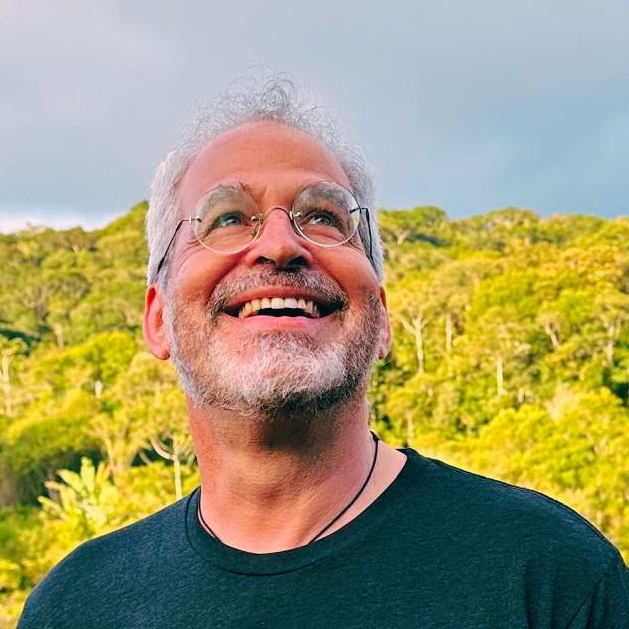
Daniel Greenberg is a 62-year-old serial social entrepreneur, community builder, and long-time nomad who has spent more than half his life in intentional communities and lives on less than $24,000 a year. (daniel@ic.org)
Daniel traces his unconventional path from graduate research on children growing up in communes to traveling around the country in a Westphalia camper van, living in communities around the world, and starting organizations that introduce people to alternative ways of living. He explains why most people don’t even think to put “community” on their list of things they want from life, the differences between communes, co-housing, and ecovillages, and why he sees these communities as laboratories for figuring out how humans can live well and lightly together.
Today, Daniel bounces between communities in Massachusetts, Scotland, India, and Brazil, carrying almost everything he owns in a backpack and carry-on. He has about $8,000 in the bank, owns a house that doesn’t generate income for him, and somehow manages to put a daughter through college. Daniel describes why planning too far ahead can actually make his life worse, how he thinks about his extraordinary network of friends as a form of wealth, and the messy realities of living alongside other people, from incompatible kitchen standards to the challenge of “cohesion without coercion.”
Finally, Daniel reflects on why he’s never been particularly interested in maximizing his salary and why his guiding question isn’t “Where should I go next?” but “Where do I need to be, who do I need to be with, and where can I contribute?”
Full transcript: dirtbagrich.com/daniel
Recorded in August 2026.
Transcript
This is an AI-generated transcript. Typos and mistakes exist!
Blake Boles (00:00)
Daniel Greenberg, welcome to Dirtbag Rich.
Daniel Greenberg (00:03)
Thanks, Blake. Great to be here.
Blake Boles (00:06)
Of your adult life, what percentage has been living in community and what percentage has been living on your own?
Daniel Greenberg (00:15)
All right. it’s not exactly a black and white question. They there are overlaps, but very quickly I was born in upstate New York, Ithaca, Hippy Town, and then when I was six moved to suburban Delaware where I lived with my parents and my older brother and sister until college, and then it was roommates and then grad school, it was co op houses and increasingly community. And I and I met my wife. Actually the first place we moved into
was a Westphalia camper van and we traveled around the country to communes. my my doctoral research was on children and growing up in communes. And Monique was looking she was creating a documentary. And so we we did that. That was back in like 89, 90. And I’ve lived in lots of different communities. For the longest stretch, I did own a house, I still own the house, across the street from a community in western Massachusetts called Sirius, like the dog star, S-I-R-I-U-S, not serious.
and my two daughters grew up there and now I bounce around a lot to different communities. So I don’t know if I could step back. I’m sure over half of my life has been in community.
Blake Boles (01:28)
Does it seem accurate to say that most people never live in community out o outside of the community of of a nuclear family? The kind of communities we’re talking about that might be called intentional communities.
Daniel Greenberg (01:41)
Well it’s all definitional, right? I mean, what do you mean by community? In some ways, we’re we can’t not live in community. I mean, we’re in relation not just to our with our family and friends, but with our neighborhood. I mean, now increasingly people’s community is online. And then of course we’re in community of life on the planet. So it’s just a question of framing, I think. But I understand where you’re coming from. And I think I think most people, in at least in the way that I think of it. Community isn’t even something they think about. I I used to run a nonprofit that we did study abroad and we’d take groups of college students to ecovillages. And when I was talking in classes, I would ask students, it’s like, so what do you what do you most want out of life? And they would say, I want a a nice house, a a nice partner, opportunities to travel. Very, very rarely did I hear any of them say, I want to be in community. I want to feel a part of something bigger. I just don’t think it’s even on the radar for most people. So I think I agree with you all that to say.
Blake Boles (02:45)
Let’s get into some definitions here because we’re already throwing around a number of phrases that might be alien, like intentional community or eco village. You use the word commune. maybe just quickly l lay out the the territory here
Daniel Greenberg (02:58)
Sure.
Blake Boles (02:59)
and and what used to exist and what exists now.
Daniel Greenberg (03:02)
Okay. I’d say the biggest umbrella term would be intentional community. but even there, there’s probably a whole other range of communities that are more indigenous, more village based, that also feel community but weren’t necessarily intentional. So e there’s there’s no definition that works really well. Under intentional community, there’s the word commune, which was kind of everything back in the sixties and seventies.
but it got a lot of baggage, right? A lot of people started judging, those hippies in the woods, sex, drug, and rock and roll, all that. and so people started dropping the word commune. It’s still used, but nowadays it’s more typically used to describe communities that are really tight-knit, that are typically income sharing. and then you have ecovillages, which is also a subset of community, and those are communities. I I my definition is that an ecovillage is simply
A group of people that are trying to live high quality and low impact lives together. How do we live well
Blake Boles (04:06)
Mm.
Daniel Greenberg (04:06)
and lightly together? To me, that’s the essential question, not just of community, but of humans, right? I mean, we we all have to figure out how are we going to get below the carrying capacity of the planet and at the same time allow everyone to rise above what some might call an equity baseline, that we have at least minimal access to a good life.
Blake Boles (04:28)
The reason I find this all really interesting, Daniel, is that there’s a lot of people out there who are super into the outdoors. They want to spend their time in nature, want to go hiking, biking, skiing, rafting, and that is their their connection to nature. At the same time, they are questioning kind of traditional modes of employment and burnout and and finding ways to be self employed or flexibly employed. Yet these people who
have these values are often I’d say not exposed to different ways of of living, really like physically living outside of either your own house, your own apartment. And the ideal seems to be like meeting some romantic partner who you then can move in together with and share space with. And maybe you start a family, maybe you don’t. But going beyond that, especially when you use a phrase like like income sharing,
starts to feel I I think really threatening because
Daniel Greenberg (05:29)
Mm.
Blake Boles (05:29)
th there’s this level of of independence and self sufficiency and privacy that we associate with having your own place and and community is to be found outside of your domicile. Maybe you invite people in for a a dinner party every now and then, but
Daniel Greenberg (05:47)
Mm-hmm.
Blake Boles (05:47)
but you you find it out in these third spaces. You you go do activities, outdoor activities with your friends. You you travel together.
Daniel Greenberg (05:53)
Mm-hmm.
Blake Boles (05:54)
And so what about this
vision of of what it means to be self-sufficient
Daniel Greenberg (05:59)
Yeah.
Blake Boles (06:00)
or to have made it. What what doesn’t line up with with you and and your own experience?
Daniel Greenberg (06:06)
Well, I mean it’s true. The US and most Western countries are very individualist, whereas a lot of Eastern countries kind of presume more community. And so it’s often something, again, that they’re not even looking for. But my guess is that if everyone, like say in the US, could experience community, I’m betting at least half of them would say, hmm, there’s something here, right? Not everyone. I mean it’s it’s definitely not something for everyone, but I think it’s for a lot more people than we might expect.
And there are lots of advantages. And the things that you bring up are are common judgments or criticisms or or concerns about community. Will I have my own room and can I be in charge of my own income? do I get to travel when I want? And that ranges, right? I mean, I mentioned communes on one end in terms of income sharing community. On the other end, you might think of like co-housing, which I think at least for a time was the fastest growing development style in
North America, I think. And so there are co-housing communities pretty much in every state. and there it’s kind of you know, y you can live your life and you’re in charge of your own income and stuff. And yet it’s designed to facilitate more communities. So there might there’s usually a common house that we could have maybe meals that you don’t have to go to or you or cook, but you can. There might be places for childcare, offices.
And because they’re a collective and they design their whole community together, they can kind of crunch together the houses and other buildings and then leave the proper most of the property natural. So many commun co housing communities also have a lot of access to nature too, which people find surprising and and surprisingly gratifying.
Blake Boles (07:50)
If someone just moves in with friends into a house and maybe come up with a system for keeping the kitchen clean and who’s gonna clean the bathrooms, would you consider that community?
Daniel Greenberg (08:00)
Sure. I mean, to me, community is just a state of mind, right? I mean, think of let’s go further. Let’s think about like an apartment complex in New York City, right? And let’s say you don’t know anyone, right? You just have your you just have your apartment. That’s very, very common. and and yet maybe someone in the apartment has an idea. Like they l what would community look like? So they put out maybe a a a memo to people and say, Hey, who’s in on this? They get together and say, Well, you know, if we all just chipped in like 10 bucks a month or 20 bucks a month.
We could actually rent another apartment and it could be for all of us. Like we could, we could reserve it. We could have parties there. We could have classes there. We could have childcare there. You know, and then they could say, like, well, how about food? Maybe we could look at joining a CSA in a community sported agriculture. And we could look at how we can get bulk foods that would save us money. You know, the the the idea of community is bigger than any form it takes.
And so it’s really just an awareness and an impulse to live in greater harmony with each other and the planet. That naturally leads us toward community.
Blake Boles (09:07)
those are some pull factors. For me, the the push factor towards community is that I just find it really lonely to to have
Daniel Greenberg (09:16)
Mm.
Blake Boles (09:16)
my own place. And and there’s been a few times where I have had my own small cabin, I’ve had a a rented room in a place where I don’t know anyone else. and I’m I’m just thinking, man, how do people do this day in and day out, year in and year out? And I can then imagine the drive to try to
Find someone to couple up with and to you at least have one person there. But I think that can turn into its own kind of pressure cooker. have you felt this this push factor too? This go ahead. Yeah.
Daniel Greenberg (09:44)
Yeah. interesting. I
I think I’m on the other end. you know, I just realized a couple years ago, like I I I’m still married to my wife. we uncoupled about seven years ago. And so I moved to an apartment. This was actually in a community in South India called Oroville. And so when I moved into my own place, I had this epiphany when I realized I had never lived on my own my whole life. You know, I grew up with a brother, we shared a room.
And you know, family and then college and then f and then family again. and I love it. You know, so I’m sort of on the other end. I’m now house sitting for a couple of weeks, taking care of some cats in Western Massachusetts. And you know, I just love every moment I I get on my own. I think so. Well, but
Blake Boles (10:26)
Well you’re you’re like the the junkie who’s O D’d on community and and now you’re like, being sober can actually feel pretty cool.
Daniel Greenberg (10:33)
but but you know, let’s let’s modulate that because I also very much enjoy community and I feel like I have
many communities in my life. Actually, you know, so I mean we can kind of back up and and look at how this happened, but I feel like I have at least five communities. One is Sirius community where I have a house across the street, and that’s where my daughters grew up. Another community is is this large international community in South India called Oroville, and I’ve spent years there too. And then Findhorn in Scotland, which I’m sure some of your your listeners have heard of. It’s probably the most famous
eco village in the world in in northern Scotland. And then I also have a community, I I do this thing that just happened recently called Dance Camp and I manage the young persons program there. But even though that’s only comes together maybe eleven days or two weeks a year, it’s a very tight community. And then the fifth community I would say are the people in other communities that are also butterflies, like me. I mean
In any community, there’s a a range. On one end, there’s people who are just like, This is my home, I want a garden, I don’t want to cut down another tree, I don’t want another member. I I like it just the way it is, right? I’m on the other end who’s always imagining what it could become, and we should connect to this community, that community. So I go to the events and the gatherings and the conferences where other people in other communities are also thinking like that. And a lot of these people I’ve known for 30 years. I’ve never met their partners, I’ve never been to their place, but their family, right? So
Yeah, I feel like I have an abundance of community in my life.
Blake Boles (12:02)
So you’re just flitting like a butterfly in
Daniel Greenberg (12:04)
What?
Blake Boles (12:05)
between one community and and just give me a si a sense of scale here, how many people in these communities that you’re describing?
Daniel Greenberg (12:12)
Well, I the the main community is okay, so yeah, it’s a good to range. So Sirius is on the smaller end. They have maybe thirty residents. they’re actually a spin-off of Findhorn in in northern Scotland. Findhorn is is mm I also it depends on how you cut it, but I’d say probably between four and five hundred people. Findhorn’s gone through a big change that I could talk about. but they that’s that’s a very alive community. I would say they have one of the most
mature social ecosystems, because people there have known each other forever. And then there’s Oroville, which is on a whole other scale. in fact, most people there don’t like it when I call them anika village. Their vision is to become a city for 50,000 people. Currently there’s around thirty three hundred people from I think close to sixty different nations. And they’re trying to build a city the earth needs, a city for building human human unity. And it’s essentially an experiment in human consciousness.
It’s it’s an amazing place. It’s crazy right now. They’re in crisis. but it’s still one of the most amazing places I know on the planet.
Blake Boles (13:19)
This is probably a good time to say for the record that you are the co director of the Foundation for Intentional Community.
Daniel Greenberg (13:25)
Wmm,
kind of, not quite. I came in as a co-director, but I’ve been backing up. and so before me there was five directors that was un unwieldy, so they brought me in with just one other person. But then quickly I realized that that other person could do it all. And so I just said, Look, can I just have fewer hours and I’ll just be the director of networking and partnership and kind of just do what I want. and now they’re actually struggling financially. So I’m even backing up further and I’m more of a support person.
yeah, so that but yeah, I’m very connected to that that organization. For sure.
Blake Boles (13:58)
Okay. Yeah, you’re connected to the Foundation for Intentional Communities.
This was on my radar a long time ago because it was the preeminent website IC dot org
Daniel Greenberg (14:04)
Hmm. I C dot org. Yeah, yeah.
Blake Boles (14:08)
that lets you quickly see these different kinds of intentional communities all across the world, see if they’re open to new members, get a little sense of their
Daniel Greenberg (14:17)
Yeah.
Blake Boles (14:18)
their governance, their how they do resources, what their values are.
Daniel Greenberg (14:21)
Yeah. And and we just
redid our website along with the Global Eco Village Network. And so we’ve combined our databases, lots more capabilities. So this is actually just in the last week or so. So really encourage your listeners to check that out,
Blake Boles (14:33)
Yeah.
Daniel Greenberg (14:33)
ic.org. And actually I and if they want to contact me, I don’t know if this is okay, but it they I I’m just
Blake Boles (14:36)
Sure, go for it.
Daniel Greenberg (14:37)
Daniel at ic.org. Very simple to remember. And I’ve had that email probably since nineteen ninety one, I think. so it’s one of the longer ema longer existing emails.
Blake Boles (14:48)
Yeah.
So we’ve been talking about lots of different sizes, shapes, flavors of intentional
Daniel Greenberg (14:53)
Mm-hmm.
Blake Boles (14:54)
communities. It’s definitely worth browsing the website to get a a flavor for it. But I want to get a little bit more into your story and your life. Daniel, y you told me when a mutual friend connected us that you live on less than twenty-four thousand dollars a year pretty regularly, and that your life feels incredibly rich ’cause you get to go to all these different communities, you have all these different
Daniel Greenberg (15:15)
Mm.
Blake Boles (15:16)
friends.
And I want you to to maybe demystify this a a little bit for us. Like how are you able to travel nearly full time
Daniel Greenberg (15:26)
Mm.
Blake Boles (15:26)
with so little money? And and do you have any like hidden sources? Did you work really hard and save a b bunch of money and you’re living off the interest now? Do you have family money? Like walk me through w how the mechanics of your life,
Daniel Greenberg (15:35)
No. No. So okay. So none of that.
Blake Boles (15:40)
yeah.
Daniel Greenberg (15:40)
None of that. I probably have about eight grand in my account. and that’s pretty much it, which actually to me feels fairly luxurious. It like I’m my goal is kind of around ten thousand. That gives me a sense of a little bit of safety. I mean, if something major happens, that’s a whole other thing. yeah, I mean, so I there’s not and but I would
I would also maybe reflect back what does wealth mean? Right. So like I I’m
Blake Boles (16:07)
Please
Daniel Greenberg (16:08)
I’m I’m poor financially. And yeah, I I actually don’t track it carefully, but I’m sure it’s under twenty four, maybe even under twenty thousand. And I’m putting my daughter through college, which is astonishing me. Like I don’t know how I do it. I almost kind of worry, like the closer I look, I’m gonna it’s gonna s fall apart or something. It’s like, you know, like when you’re in a plane, like how does this thing actually stay in the air? and so I don’t wanna question it too much, but it’s
But it’s working. But in terms of wealth, I do feel like I am in a way harvesting a lifetime of cultivating relationship and and community. And so here’s an example. Like, so two years ago, I went to Oroville and I and I wanted to spend a s significant amount of time there. And yet I didn’t know where I was gonna stay. Now India is not too expensive, but I was still that was a that was a a question mark. And then a friend like contacted me out of the blue, said, Hey, look.
We actually knew each other because we lived together at Findhorn in Scotland in the early nineties. And he’s like, I’m I’m gonna be away for like six months and I attuned, which in Findhorn language basically means kind of meditated and said, What do I do with my place? And he said, Daniel came up. And so he contacted me, he said, Daniel, would you like to stay in my place for six months? And I’m like, Yeah. And it was amazing. I mean, it was like all things together, it was like fifty bucks.
less, like forty dollars a month for for, you know, the space, for the the heating, the water, whatever. and so those kind of th things just show up, not always. but the more I trust, the more I feel like, yeah, I’m on path, this is working out, this is what I need to do. And I listen. And this is actually something that might be interesting for your listeners too. That when I when I think ahead and I plan, I’m I notice that
If I plan too far ahead, like, this is where I’m gonna be next summer, usually life intervenes. what is it, the John Lennon line that life is what happens when you’re busy making other plans? So life happens. And then usually when it gets closer, I’m like, shit, you know, I wish I had not made that plan. And so more and more I’m kind of just allowing things to unfold, even when it gets into that uncomfortable place of like, you know.
I really should figure that out. It’s like that’s not so far from now. But
Blake Boles (18:30)
Mm.
Daniel Greenberg (18:30)
I notice if I sit even a little longer and just say it’s okay to be uncomfortable, that’s often when the magic happens. That’s when like, of course that’s the next step. Of course that would ne but it but it’s a it’s like almost a spiritual journey for me because it really requires this deep trust that I I will be taken care of if I feel like I’m here doing what I need to be doing.
Blake Boles (18:53)
Hmm. You’re really speaking to me here, Daniel, because
Daniel Greenberg (18:56)
huh.
Blake Boles (18:56)
I live a similarly nomadic life, lots of different locations, and there’s this this tripwire to walk between future planning, which might mean getting cheaper plane tickets, or locking in some housing opportunity,
Daniel Greenberg (19:10)
Mm-hmm. Mm-hmm.
Blake Boles (19:12)
being able to make plans with someone who might make other plans if you don’t schedule far in advance, versus the serendipity of these
you know, sometimes very last minute opportunities that
Daniel Greenberg (19:24)
Yeah.
Blake Boles (19:24)
pop up. And and I’ve needed to migrate away from being a plan a full year out type of person. My my friends can verify this and trying to just scale that back to okay, maybe
Daniel Greenberg (19:33)
Mm.
Blake Boles (19:34)
I can just plan six months out. Maybe I can I can be okay with just three months of planning. But beyond that it’s still a really big like emotional challenge for me to feel secure.
Daniel Greenberg (19:44)
Here’s an example. So when I was in Orville last winter, there was a plan for the FIC, the Foundation for Intentional Community, to have a staff and board retreat in an Eco Village near Sao Paulo in Brazil. Okay. I’m like, cool. I’d never been to Brazil. The Living Roots program I mentioned earlier, we ran programs there, but I’d never gone myself. So I was really interested. And I bought my tickets. Then the board decided to postpone or cancel the retreat. And I’m like, hmm. Well
There’s nowhere else I need to be. So I’m going. You know. So I just went to Brazil and I kind of intentionally didn’t plan. All I knew was where I was going to land in this in this ICA village. And I really didn’t understand or know Brazil at all. And what I I didn’t know how long I was going to be there, maybe a couple of weeks. It ended up being about two and a half months. And it was just glorious. One thing led to another. I actually started two amazing relationships while I’m there, while I was there. I’m I’m also been non-monogamous for 30 plus years.
and it just unfolded. And so for me, that was a case study of what can happen when we just trust and just go with kind of listening to the universe in a way. I know that sounds kind of woo-woo, but I think we all have that sense. I think we have like a sixth sense of are we on path? Are we doing the work we’re here to do? Right. And when we’re not.
People get frustrated, they get lonely, they get anxious, and then they look for how what to how to fill that gap. And our society fills it with consumer stuff, consumer stuff, entertainment, porn, whatever, right? And I’m saying, no, it’s actually something deeper, even deeper than community. The deeper thing is like, what am I here to do? What are the deepest questions that I’m trying to ask? and the more we’re in touch with that, the more we’re following that, I just think the universe shows up.
Blake Boles (21:40)
I would like to yes and all of that and and maybe
Daniel Greenberg (21:42)
Yeah, go for it.
Blake Boles (21:43)
take a crack at de woo-ifying it, which
Daniel Greenberg (21:46)
Please.
Blake Boles (21:47)
is you seem really good at at human connection, at meeting people, whether individuals or or groups, and quickly finding a way to to to essentially to like them and to let them like you and probably to be useful to them and want the and have them want to keep you around. Am I being accurate here?
Daniel Greenberg (22:11)
humbly yes.
Blake Boles (22:12)
Yeah, yeah, great.
And so I I feel like the insecurity that you’re describing that leads to these these impulses to consume more stuff, then we need to make more money in order to consume more stuff, to purchase more privacy. I I think that is probably rooted in this feeling of like I don’t know how to do community. And I I feel like I I witness this among a lot of young people who I’ve worked with, which is when they get to taste like
this really vibrant summer camp community or this little traveling pod for a while. they’re like, this is amazing. I I no longer need all these other things that I I thought I need, these creature comforts. And I have no idea how to to reproduce this in my own
Daniel Greenberg (22:58)
Well, yeah.
Blake Boles (23:00)
life. Whereas you you don’t seem worried about that because you have these decades of of ninja skills of community and and human
Daniel Greenberg (23:07)
Well,
Blake Boles (23:07)
connection.
Daniel Greenberg (23:08)
maybe, but bigger than that, I would say none of us really know how to do community. We’re all figuring it out as we go. Right? There’s a wonderful Japanese saying that if you want to clean potatoes, one of the ways to do that is you throw them into a pot with some water and you shake, right? And simply by their rubbing against each other, they kind of clean each other. And community can be like that. I’ve known many people who’ve come to community a naive, maybe h strong willed or opinionated.
And it’s a beautiful thing to watch over time witnessing them taking other people’s perspectives, maybe using more kind of NVC or language or speaking I statements, slowing down, pause. You know, all those things happen in community, but it’s not like a black and white, you’re a fit, you’re not. It’s more like the intention. Like if it’s something that someone is genuinely wanting to develop, communities are more than most are more than willing to say, yeah.
We can work with you. Let’s let’s try this out. And I mean, geez, the the the biggest communities I know, Finhorn and Oroville, are kind of the the the grandparents of the whole movement. And they’re they’ve both been melting down. Finhorn had a huge crisis through COVID, and Oroville is in it right now. There’s almost this like slow-motion government takeover happening of Oroville. And there’s two sides. I don’t think either of them are right or wrong, but
It’s as I said earlier, it’s a it’s a whole community whose raison d’être is about building human unity. And yet they’re so polarized right now. So I have to step back and say, wow, you know, we’re in kindergarten. I mean, as a species in terms of where we need to be with what it means to be in community with each other in all life, ecovillages, I don’t know, maybe they’re first grade, second grade. So we all have a long way to go. And I think eco villages are wonderful.
laboratories, they’re wonderful test beds, kind of beta test centers for w who we can become. But yeah, I I these days I’m a little frustrated.
Blake Boles (25:13)
Mm.
Daniel Greenberg (25:14)
I kind of want to shake them because we you know we’re in this moment in planetary history. And I do believe we are at the threshold of something. It could go good, it could go bad, it could go both, right? but we need to kind of show up for this. And I think Eco Villages
are at the cutting edge of what that could look like. They’re the best campuses we have for this kind of education. And yet okay, I mean I I I this isn’t this isn’t a broad statement. I mean there’s lots of great things happening. But as a whole movement, I feel like we’re kind of coasting. We’re kind of just sort of like, yeah, we we want to create a nice community. We want to kind of be stable and sustainable. but I’m like, no, you guys are are potential pivot points in this great turning.
Joanna Macy for those who have know her, you know, talking about this threshold moment in in history. And I think ecovillages have an opportunity, maybe even kind of an obligation, to be part of that change.
Blake Boles (26:13)
Well, I think a lot of people out there might have a like a cool, very vague idea of what an eco-village or co-housing might look like. some other people like you and me and a number of people we probably both know have lived in student cooperative houses back when we were in college. But I I again want to take this down to the most accessible level, which is like living with friends as roommates. And I’m curious, just to choose the the most tendentious
place that community, you know, where community can disintegrate. It’s the kitchen. And I’m curious I I think there’s a lot of people who when they imagine living with their friends who they enjoy going on on trips or adventures with, you know, meeting up to go to a restaurant. When they imagine living together and having to deal with someone else’s let’s say, messiness in the kitchen or the bathroom, or their hyper cleanliness and and
Daniel Greenberg (27:11)
Mm.
Blake Boles (27:12)
ridiculous standards from my point of view, in the kitchen or the bathroom, then they think, man, if we actually live together, we would not be friends
Daniel Greenberg (27:21)
Hm.
Blake Boles (27:22)
for very long. But, you know, we can just tolerate each other briefly if we go over to each other’s places or if I spend a few nights at staying with someone. But there’s this idea that like conflict is inevitable and conflict is destructive. And I and I feel like that is somehow the root of why
most of us think, these big communities living you know, intentionally with other people. That’s for other people. That’s not for me because
Daniel Greenberg (27:47)
Mm.
Blake Boles (27:47)
I need my my space and and my standards and that’s what I need for my my own mental health. Otherwise I won’t be able to show up as a very good person if, you know, somebody with different standards is is in my space all the time. how does this land with you?
Daniel Greenberg (28:03)
Yeah. Well, th there’s a lot of truth there. and it can work well. I I remember the first co-op house I moved into, I did my graduate work at in at the University of Minnesota in Minneapolis, and I moved into a group house the summer before. And one of the persons living there was like I think he called himself a fruitarian, which was beyond vegan. Like he would only eat fruit that like fell off the tree. I think. Yeah, yeah. Yeah, exactly.
Blake Boles (28:27)
Yeah, fruits and nuts. So you’re not harming part of the the the vegetable.
Daniel Greenberg (28:30)
And the same house
There was a guy who was a hunter and he would have venison in the freezer, right? And so and yet we all got along. And I think you know, for me, it’s it’s like what is the deeper intention? W why are we together? And to try to ev for everyone to loosen their attachment to the form of what that looks like. So some people might come into community and say like, I need quiet from ten o’clock PM or
you know, I don’t want this kind of food in the house or whatever. But then it to step back and say, like, okay, what’s what’s the deeper intention and to see like can we cohere without coercion? To me, that’s the thing. Like can we
Blake Boles (29:15)
Mm-hmm.
Daniel Greenberg (29:15)
can we come together in a way that we’re not forcing another person to do something, but we’re all aligned to that deeper vision and we’re also aware that any form is just one way
of manifesting that vision. And if we can do that, we can step back and say, Okay, let’s go back to why we’re here and maybe there’s a different way to look at this. Does that make sense?
Blake Boles (29:40)
Yeah. Yeah, I I like that phrase. Without coercion.
Daniel Greenberg (29:43)
I
there’s actually in in Oroville there’s a phrase divine anarchy. The the the one of the founders was asked back in nineteen seventy-two. Again, Oroville’s meant to become a city for fifty thousand people. And someone asked her, It’s like, well, how do you imagine this this community, this city organizing itself? And her answer was, Well, the best I could describe it would be as a divine anarchy, which is that it’s how do you create co cohesion without coercion?
And I think it’s more than community. I actually have gotten to the point where I think it’s kind of almost a a law of the universe. Like I think the universe works with divine anarchy. It’s anyway, that’s a whole other conversation. Yeah.
Blake Boles (30:22)
That is another conversation.
let’s go back. tell me about your your undergrad and graduate studies and then what other jobs, positions did you hold and and just to let you know where I’m going with this, I I want to get a sense of how much time what your time wealth has been like throughout your life. If this is something you’ve only recently come into because mm, you know, you said that you’re living off very little money and you have minimal savings, but I assume
Daniel Greenberg (30:50)
Right.
Blake Boles (30:50)
you also own a house.
Or at least partially own a house.
Daniel Greenberg (30:53)
I do own a house, but even
that the the rent from that house I’m I’m giving to Monique. So I don’t I don’t make any money from the house. but yeah, going back there there is. And that, you know, that that’s there, that’s true.
Blake Boles (31:01)
Okay. You have some equity to follow back upon. Yeah. Yeah.
Daniel Greenberg (31:08)
my older daughter and her husband live there and they’re that for the foreseeable future. So it’s not a liquid asset in any way. But any rate, going back, yeah, I started
college, I went to Cornell, actually in electrical engineering I started. And I I actually I wanted to be on the cutting edge of society, the cutting edge of our evolution. And I thought computers, artificial intelligence, that’s where it was at. I this is when we were learning basic and Fortran, right? I don’t even think C plus came out or C plus whatever that was. and then I started teaching kids computers in an after school program, realized I like kids more than computers, shifted to psychology, and then in
late night conversations with friends and how we wanted to live our lives. This the idea of community kept coming up. And for me it stuck. And so I started dreaming of creating a school for kids in a community setting. That’s what brought me to University of Minnesota in their child development and school psychology department. Naively thinking that that would then give me the skills to go ahead and create a school, which it did not, but it did give me the opportunity to do my doctoral research on
children growing up and education within contemporary intentional communities. So I studied the topic probably two years, read everything I could. I was one of those annoying researchers, sent out surveys to all the every community I could get an address for. And then as I said earlier, I mean Nick and I hopped into a camper van and started traveling. And I swear I learned more the first day I stepped foot in a community than probably those two years I’d spent studying them.
You know, it’s almost like like they’re telling a story or or singing a song and you can’t fully hear it unless you’re immersed in it. I mean, I think anyone who’s listening who’s traveled kind of understands that. You can read everything you can in the in the the guidebooks, but it’s a very different thing to being there, especially if you’re immersing in that place. Every place has its own vibe. Anyway, so then I did that, and then that got me to Findhorn.
I did my my doctoral, my my school psychology internship. I wanted to do it in a community. Finhorn said, Yeah, we could use some help with our kids. And so we moved there for a year. Amazing year. op and in the middle of that year, a friend brought over some college students for a program there, which was freaking everyone out. They were like, it was one of their first like young person program there. They’re like, they’re gonna make a mess.
Which they did. But they also was they were an amazing reflection to the community. They were they weren’t kind of bought into the whole woo-woo. They were able to be critical, but and but it was wonderful. And also they filled in a gap because a lot of the young people f that lived at Finhorn were away themselves doing college. So it kind of felt good that way. Anyway, that inspired me then to go ahead and create this nonprofit called Living Roots and we worked
with mostly the University of Massachusetts and ran these semester, summer, January programs. In Ica Villages did that for, I don’t know, 12, 14 years, which was wonderful work. I’d say in the end, probably 1,500 students went through the programs. And I would say almost all of them were really deeply moved and transformed by the experience.
Blake Boles (34:19)
Hm. S
and just to be clear, that was a sort of study abroad program. Got it.
Daniel Greenberg (34:22)
Yes. Yep. So the students
got credit through the University of Massachusetts and then we we attracted students from hundreds of different schools and then they transferred the credit back to their own school. So it was a it was an academic program, but honestly the academics was sort of the icing on the cake. Mostly what we were trying to do was to hold a container for the s for the students to sort of understand what this is, what this means, to kind of give flesh to the bones of their experience in these communities.
Anyway, that was wonderful work. I left in twenty twelve. Interested. I mean, there was I was aware that there was some founder syndrome going on. I w I kept on wanting Living Roots to develop and expand and do different things. And the staff were more like, no, we just want to have a business here. So I thought, huh, maybe I’m not that person anymore. Maybe I’m more of a startup. So I left and started a different organization, which was more about
Our environmental impacts and it’s a whole process around it’s an alternative to carbon offsetting. Don’t need to get into it. It’s a little wonky, but it’s a very cool idea. that never really got off the ground. But then I did other things and along the way I helped start something called Gaia Education, which was a spin-off of the Global Eco Village Network. I served as president. But you asked originally like my my sort of my time landscape, and I’d say, yep. Okay, go ahead.
Blake Boles (35:43)
Well, i y you’ve given me a little insight here, which is that
you you sound like a a serial social entrepreneur.
Daniel Greenberg (35:50)
Yes.
In fact that’s kind of in one of my bios somewhere.
Blake Boles (35:53)
Yeah, this doesn’t surprise
me. And and my impression of of this kind of personality archetype is that, you know, people like us can’t sit still and we need to be working on something, building something. And as soon as that thing starts to feel a bit stagnant, then hand it off to someone else or shut it down or move along to something else. And and I wonder to what extent there’s this sense of of like spaciousness and and and not feeling like you’re always grinding.
on something and
Daniel Greenberg (36:23)
Mm.
Blake Boles (36:24)
not leading towards some sort of like founder burnout syndrome. And
Daniel Greenberg (36:29)
Mm.
Blake Boles (36:30)
how much do these terms apply to you?
Daniel Greenberg (36:33)
I mean they a little bit, but when you asked originally like my time landscape, I’d say my constraints
Blake Boles (36:37)
Yeah.
Daniel Greenberg (36:38)
are through my life have been almost all self-imposed, right? There’s no one I’ve never that in my memory had to like punch a time card, maybe when I was a teenager and I worked at Rustler’s Steakhouse or something. I can’t remember, which is one of the reasons I’m vegetarian. but mostly it’s things that I am doing because I’m genuinely wanting to do them and because I’m passionate.
That can take a lot of my time. and the passions changed. When I left Living Roots, my dream was that it would continue and prosper, and I could look and say, Look what I started. unfortunately, about two years later, the whole thing fell apart, which is a whole other story. and it was very sad. And my mom used to say, if you can’t set a good example, at least be a horrible warning. And sadly, in the end, Living Roots became a horrible warning.
about crisis management and things like that. It’s another story.
Blake Boles (37:31)
Mm.
Daniel Greenberg (37:32)
But yeah, I mean, so I try to follow my passion and what do they say? If you love what you do, you you you’ll never work a day in your life.
Blake Boles (37:39)
Yeah.
Daniel Greenberg (37:41)
and that definitely applies to me.
Blake Boles (37:42)
Yeah. And this whole question keeps coming up in these interviews that I’m doing of what is considered work. And just to even ask someone I think that’s similar to you, how many hours a week do you work is a genuinely difficult question to answer. And and even
Daniel Greenberg (37:58)
totally crazy. I d yeah.
Blake Boles (38:01)
to differentiate paid work from unpaid work or or the kind of stuff you’re doing, like you’re meeting people that at some point in the future might lead to some connection that maybe becomes paid work but maybe it’s not paid work and
We just create a project together and actually it it all falls apart and and how do you how do you put down any billable hours for yourself as a as a self employed person?
Daniel Greenberg (38:18)
Yeah. Yeah, I I can’t. I I
don’t do that anymore. I mean it’s like I’ll do projects and I hate when I’m in a situation where they say, Hey, you have to track your time. I just doesn’t work for me. Like I’m always multitasking, I’m always doing a couple of different things and it’s th that gray area. It’s like, is this work? I don’t know.
Blake Boles (38:35)
Yeah.
Daniel Greenberg (38:35)
I just don’t want to even think about it. I just do. yeah.
Blake Boles (38:38)
Well,
i here’s an interesting question for me. At at what point in your life, Daniel, did you feel like the the pressure to reliably make a good amount of money through work decreased or or even disappeared? And and you were really like in in cruising mode where you can just do stuff that you’re interested in and not worry too much about whether it leads to money or not, because you have this this fundamental sense of
Daniel Greenberg (39:03)
You know,
Blake Boles (39:04)
security.
Daniel Greenberg (39:04)
you know, honestly, I think there’s probably a couple wires in my brain that are not connected. Wa one of them is to recognize how difficult something will be. And I think this is probably you may have this too, that it’s it’s typical of serial entrepreneurs that if I knew how hard things would be, I probably wouldn’t do wouldn’t have done half of the stuff that I did. So there’s this naivete going into stuff. what was the other side of the question? There was there was
Blake Boles (39:31)
Well, a have you reached the point? It it seems like you have reached the
Daniel Greenberg (39:34)
yeah.
Blake Boles (39:34)
point where you just like stop worrying very much about whether what you’re working
Daniel Greenberg (39:37)
Yeah.
Blake Boles (39:38)
on creates money or not. ‘Cause I I feel like that’s the the sort
Daniel Greenberg (39:40)
But in
Blake Boles (39:41)
of golden land of of retirement in in people’s personal
Daniel Greenberg (39:43)
Yeah.
Blake Boles (39:44)
mythologies.
Daniel Greenberg (39:45)
But you know, I I I don’t think I ever had that. I mean, yeah, I was in grad school and all my friends were kind of on track and they were getting these either academic jobs or high paying jobs and I just never went that route. And something I really deeply appreciate about Monique is that she was with me on that. She was like up for the adventure. and so we traveled together in a Westphalia camper van and then she said, Go for it when I said I want to
Do this crazy thing and start this nonprofit that really never one year I think I made like a half decent salary, which was like maybe 50,000. And then suddenly that was in 2008. And then there was the economic fall-off, and then we were back to like 24,000. I’ve never made a lot of money. and honestly, it’s been a saving grace. Like, I know people who make lots of money, and yet they look at me and they’re like, I want to do that. And I’m like,
So why don’t you have so many more resources than I do. But there’s these like golden chains and they dr they’re like on this treadmill that they don’t know how to get off of. And so maybe I never got on it?
Blake Boles (40:56)
have people say similar things to me. Yeah. So
Daniel Greenberg (40:58)
Yeah.
Blake Boles (40:59)
I think this is why you’re on this podcast, Daniel, because you just explained that you essentially never took a job for the the primary purpose of salary. You’ve always been following the sense of like deep purpose, which writ large is community for you. And and you’ve had a very good life with a pretty well what most people would call meager resources. Even though you have managed to
fulfill a certain aspect of the American dream, you know, having a house to your name. Yeah. Hm.
Daniel Greenberg (41:28)
Mm-hmm. And that only
happened when my grandfather sadly passed away and there was just enough inheritance to put a down payment on the house. And we said, Let’s do it. And that
Blake Boles (41:37)
Got it. Yeah.
Daniel Greenberg (41:39)
was in retrospect a very it was a wiser decision than I think was we merited at that time in our lives. That was kind
Blake Boles (41:46)
Yeah.
Daniel Greenberg (41:47)
of a lucky break.
Blake Boles (41:48)
Yeah. And you told me when we spoke before this recording that while you’re often out in nature or or hiking, doing big stuff out in nature, big, you know, sports, adventures, that that’s never been a big part of your life.
Daniel Greenberg (42:02)
No, I mean I enjoy that. I like camping. I love hiking, swimming. but I don’t like my my when I when I think about my nomadicism, it’s not around nature activities. It’s around community.
Blake Boles (42:15)
Yeah, yeah.
Yeah. Yeah, I I’m curious about that because I feel like I’m increasingly moving in that direction too. A and that a lot of my travels are not for this sake of of seeking novelty through going to new countries, doing new things, checking off lists, nor are they primarily for big outdoor adventures, although I still do a good amount of those. It’s really to go back and circle back to the friends who I’ve met largely through
partner dance, but also friends from summer camps where I’ve worked, friends thro in the alternative education world, and just going and and visiting them and being part of their lives for these these brief periods. I I’m
Daniel Greenberg (42:56)
Mm-hmm.
Blake Boles (42:57)
staying with a friend right now in Portland, Oregon, who I met through the student cooperatives back at Berkeley. And and to me this is a a very deep well of purpose, getting to stay face to
Daniel Greenberg (43:07)
very much.
Blake Boles (43:08)
face connected with these people who are important to me. Much
Daniel Greenberg (43:11)
Yeah.
Blake Boles (43:12)
more so than
Big adventures, new travel destinations, all that stuff.
Daniel Greenberg (43:15)
Or even just like
the the digital nomads, right? Like I I met a couple last year that were kind of big names in the digital nomad world. They’ve written books, they have podcasts, they’re like big into that. And in talking to them, I came to realize like, I’m doing something very different here. Cause they’re well, their
Blake Boles (43:31)
Yeah, spell that out for me, yeah.
Daniel Greenberg (43:33)
their conversations were around like, okay, how where’s the best place to be in October? Like if what are the this festivals happening or what’s the the city with the best weather?
And they’re looking at how to travel differently. Like they do these transatlantic cruises. I guess they’re called repositioning cruises, because I guess the ships have to go from Europe to the US or backwards.
Blake Boles (43:56)
Sure.
Daniel Greenberg (43:57)
And so they’re cheaper, but they’re in the ocean, but they’re you know, but for them that works. And I’m like they’re all thinking about kind of how to maximize their digital nomadism. And that’s just not my question. My my question is where do I need
to be and who do I need to be with and and where can I best contribute and serve. So, you know, these days I mostly bounce between Oroville, Findhorn, Sirius, and now Brazil is becoming a place that I think I’ll be I I’ll definitely be going back there in the spring. and then there’s other things that happen, but those are kind of the skeleton of my my travels.
Blake Boles (44:38)
When you meet people and they make assumptions about you, like maybe you were assumed to be a digital nomad, maybe you’re assumed to be a trust fund baby, I don’t know. Wha what kind of im impressions do you feel like you’re you’re giving off to people that you often have to correct if they just
Daniel Greenberg (44:54)
Interesting.
Blake Boles (44:54)
hear the the high level bullet points of of your life as you lead it?
Daniel Greenberg (44:58)
I mean, I don’t get that that much. because I think most of my experiences in community and people know me as community person. so they kinda get it. I mean, I get that more from like relatives who, as I said earlier, are making literally ten times what I’m making and yet are jealous. and they’re like, Well, there’s some secret here. What are you doing? I’m like, There really isn’t. It’s just kind of
I you know, and I can get by with little. I I mean I I’m very proud that I’ve brought my life down to basically a a carry-on bag and a backpack. But I have luxury in there. Like I have a I have a split screen, you know, I have a MacBook air, I think it is, and then I have these screens that I can put on either side. So wherever I am, I feel like I’ve got a like a multifunctional office here. and I think all of my worldly possessions. I just helped my older daughter move a couple days ago.
And it made me reflect like all of my worldly possessions I think I could probably fit into two cubic yards. And and this summer,
Blake Boles (46:00)
Amen.
Daniel Greenberg (46:00)
this summer I’m actually intending to cut that in half.
Blake Boles (46:05)
that’s great. okay. Let’s circle back to community and and again I I feel like there’s a lot of these keywords that people might have heard of, but like the actual visceral experience of being there is still pretty elusive. And I’m wondering if there are any specific moments in any of these communities that you’ve been visiting or you’ve been a part of in recent years that you can you can conjure for me
Daniel Greenberg (46:30)
Mm.
Blake Boles (46:31)
that really give
people a s a sense of of why it’s worth it to live in an intentional
Daniel Greenberg (46:36)
Hm.
Blake Boles (46:37)
community. Like it could be a moment of conflict that gets beautifully
Daniel Greenberg (46:40)
Yeah.
Blake Boles (46:40)
resolved or something that gets built that would have never been built if people were trying to do this more atomistically. Yeah.
Daniel Greenberg (46:47)
Yeah, that’s a good question. I I remember being interviewed for a radio station years ago and their question was like okay, so you’re in an ecovillage, you wake up, what do you eat for breakfast? Like, really? That’s your question? But it’s a s it’s a
Blake Boles (46:58)
Nice. Yeah. Serial.
Daniel Greenberg (47:00)
yeah, I don’t know, Crenola. I don’t know. Anyway, but t more to your question, you know, there’s beautiful moments, there’s a there’s a richness, there’s a tapestry of relationships that form in community.
Like in Oroville, it’s a big place. It’s twenty square kilometers. And most people are on bicycles or or scooters. And you pass people all the time. You know, just going from one place to the other, you see people you know, you’re waving, you’re smiling, you have lunch. you see ten people, you just you have like a a a couple minute conversation. Or I go to the youth choir, and I’m like, I have a story about almost everyone here. I know their parents. I mean, you you could have this in a in a typical neighborhood.
maybe community does that a little more consciously, a little more intentionally, that it’s designed to support those things. But it’s really the that that fabric of relationships that I find deeply nourishing.
Blake Boles (47:56)
I have an a a theory here, which is America’s
Daniel Greenberg (47:58)
Go for it, yeah.
Blake Boles (47:59)
biggest cultural export is is television and movies. And and I feel like the the TV show Friends and and Seinfeld,
Daniel Greenberg (48:04)
Mm.
Blake Boles (48:05)
just to choose two classics, maybe golden girls also. people want those kinds of lives where
Daniel Greenberg (48:12)
Mm.
Blake Boles (48:12)
friends are just dropping in. They’re just opening the front door because they know it’s unlocked. And then like these little spontaneous moments happen. And and again,
Daniel Greenberg (48:21)
Mm-hmm.
Blake Boles (48:21)
the only models that most of us have for that are
nuclear family or living with a romantic partner, but again, that’s the N of that scenario is pretty low. There’s just not that many people involved. And when you have this broader friend community where people live nearby, they don’t live across town, so you have to schedule your adult play date with each other. But really
Daniel Greenberg (48:41)
Mm-hmm. Mm-hmm.
Blake Boles (48:43)
people are in the same physical proximity and you know, your your friend lives, you know, down the hallway from you or in the next building adjacent to you in your co-housing.
You can have those moments that we we romanticize in sitcoms
Daniel Greenberg (48:57)
Mm-hmm.
Blake Boles (48:57)
and and movies as just spontaneous, joyful, sometimes frustrating community. that’s my theory, yeah.
Daniel Greenberg (49:04)
Yeah, absolutely. I mean my my kids
had that for sure. They they were kids were coming in and out of our house, they were going in and out of other houses. A quick story. I was on my way to Findhorn. I was on a plane I w in in Logan in Boston and a couple sat next to me and we got to talking and turns out they were like the cousins of a family that were kinda like my kids’ other parents. And so then she takes out her phone and she proceeds to show me pictures of my own daughter.
on her phone, this random stranger who’s sitting next to me on the phone.
Blake Boles (49:35)
That’s awesome.
Daniel Greenberg (49:36)
And it’s because those are my daughter and the daughter of her cousin were besties. And a picture of one was going to show a picture of the other. And so, but that that’s the kind of thing. It’s just like they’re, you know, it’s it’s just it’s just part of community.
Blake Boles (49:50)
Yeah. is it actually cheaper to live in community from let’s just say a cost of housing utilities and food, th those basics, these days? Or I I’ve seen some like
Daniel Greenberg (50:02)
Mm-hmm.
Blake Boles (50:03)
figures for living in co housing that are actually surprisingly high and seems like kind of a a high end way to do things. Not exactly a
Daniel Greenberg (50:10)
Mm.
Blake Boles (50:10)
cheap dirtbag approach.
Daniel Greenberg (50:12)
Yeah, co housing can be expensive, although there are cheaper ways to do co housing and a lot of people may rent from co housing. You can do maybe houses and co housing. But yeah, I mean in general I would say it is cheaper to live in community. I mean, just the simple sharing of things that you don’t all have to have your own lawnmower or or a screwgun or whatever, you know. and sharing meals and things like that. it typically is a lot
cheaper and but I’d say the bigger variable is the larger context. So like in India, yeah, it’s cheaper to live in Oroville, but it’s cheaper to live in in India, right? And so it’s all relative to its larger context.
Blake Boles (50:52)
Sure. So how about in western Massachusetts? That’s a pretty expensive area to live in.
Daniel Greenberg (50:57)
Mm-hmm.
Blake Boles (50:57)
If someone is going to be living in an intentional community there, if you have any specific numbers you can throw out there, that would be helpful. Yeah.
Daniel Greenberg (51:05)
I I don’t have anything off the top of my head. I mean, but
they probably are available on the web. Sirius Community dot org. I can say there was a range, right? I mean, you could live there and have a whole apartment and it was more expensive. But even then the rate was less than what it would have been in the surrounding neighborhood. All the way down to I’m in a small room and my memory is I this is probably changed now, but a a number of years ago, it might have cost four or five hundred dollars a month.
That’s that’s rent and food and and i everything you need. So that’s pretty inexpensive. I I and I but c
Blake Boles (51:40)
That that is
Daniel Greenberg (51:41)
I I wanna say that I’m that’s that data is old. So don’t don’t
Blake Boles (51:45)
Sure, sure.
Daniel Greenberg (51:46)
hold me to that.
Blake Boles (51:49)
there’s something else that keeps popping up in my head when I think about living in community long term, which is am I expected to be here physically on property most of the time and most of the year? and if not, then then what does that say about my my vision of this community? Am I
Daniel Greenberg (52:08)
Mm-hmm.
Blake Boles (52:09)
selfishly expecting that all these other people
are going to be here so that I can drop back in and experience
Daniel Greenberg (52:12)
Right. Right.
Blake Boles (52:15)
this magic of community, but I’m not bound to this community in any real accountable
Daniel Greenberg (52:19)
Right.
Blake Boles (52:20)
way. I can just go flit off to another place in the world whenever I feel like it. And so yeah.
Daniel Greenberg (52:23)
Yep, yep. No, that’s a big question. It’s a question that
I ask a lot because I’m I’m that, right? I am I am relying really on other people not doing what I’m doing. and thankfully it’s what they want to do. they want to be there in the community and I tend to be more of that butterfly. But it’s a good question. It’s like, is there what am I what’s the what’s the relationship here? And I think that’s why I feel
in many ways I’m harvesting a lifetime of connections and relationships and and like even when I go back to Oroville the last couple of times I’ve been there and I’ll do it again this year, I do a whole big storytelling event and I invite people to tell stories about like Oroville’s future. And then we have a big event in the cinema and people love it. And to me, that’s something that I love and it feels like a big contribution there. and I I kind of have relaxed
Around this. Here’s another little story. At Finhorn, they have a thing called the boutique. It’s basically a free store. I mean, people drop off clothes. You can you basically you give things, you take things. There’s no money exchange there. And when we lived there, Monique was there like every day. She loved that place. And there was always something that should come by. And you know, we just her clothes pile just got bigger and bigger. And I was there was a little part of me that was a little upset, like, wait a minute, you have this is reciprocal. You have to give something to get something.
And she’s like, that’s all And it all worked out in the end, right? Because when we left, we were on some like Ryanair or something and we could she had to give everything back. And so it all went back. But a bigger thing was I started to realize, like, it doesn’t have to be tit for tat. It doesn’t have to be X and Y. And it’s like, you know,
Blake Boles (54:03)
Mm.
Daniel Greenberg (54:04)
she she was taking something in some way, but she was so generous that she is so generous in so many other ways that I’ve kind of relaxed around that reciprocity question. If we feel like we’re here doing what we need to do.
And we trust that other people are as well, or at least they’re trying to, then I think our our task is to support that and to say, like, okay, how do we help that be more and how do we help that manifestation better?
Blake Boles (54:32)
Something you’ve said a few times in this interview is that you’re harvesting a lifetime of connections and and I’m curious if you feel the same way I do that your connections, your your friendships, the people you’ve collaborated with in the past, and also just straight up old family and friends, that these are your real safety net. Like this is your retirement plan, so to speak. And that if
Daniel Greenberg (54:57)
I yeah.
Blake Boles (54:58)
if if your your financial resources, your your equity
went away, this is what’s really gonna to save you from actual impoverishment.
Daniel Greenberg (55:08)
Yeah, I feel so wealthy in that regard. it also shows up in the world of non-monogamy. A lot of people say, like, well, if you’re non-monogamous, who who’s gonna be there for you and when you’re old and decrepit, right? And and I’m like, actually, I can think of half a dozen people that I would want to support in that way, and that would probably support me. It actually feels much more distributed. it it it feels there’s a a bigger area of support than I think I would have felt
Otherwise.
Blake Boles (55:38)
I I like the phrase a diversified relationship portfolio.
Daniel Greenberg (55:40)
Yeah,
they I like that. Yeah. Yeah, so I’ve been investing in that my whole life.
Blake Boles (55:43)
Please use it. Yeah. Yeah.
Yeah. Yeah. Yeah. Great. Daniel, as we’re wrapping up here, I’m curious just is there anything else that since you have such a a lifetime of experience being part of all these different communities that that are still pretty opaque to most people, is there anything else you can you can offer just to give us like a little insight into why you’d want to seriously consider getting involved with a more formal
community. yeah.
Daniel Greenberg (56:15)
Well,
I mean, I don’t know if I I would. I mean, I at this moment, I mean at this
Blake Boles (56:20)
That’s honest. Okay.
Daniel Greenberg (56:21)
moment I I I the more I do this, the more I feel like a global citizen. You know, like I can step back and kind of see like, here we are, humans, at this moment, trying our best to survive with a lot of old stories running around that are kind of r throwing us over a cliff. How do we do this? And I see communities
as these little test beds, right? And they’re and I and a lot of my life work now is around how do we connect those communities together more? How do we create exchange programs and and ways of mutual support so that we can build that infrastructure, almost the neurology of a global intelligence, a global coordinated system. To me, that is deeply exciting to me. And I can’t do that in one community. So it really I’m feeling more and more like I’m
In the community of humans, I’m on this planet and we’re all trying to essentially do the same thing. And can we back up a little bit and say, like, actually, you’re wanting the same thing I’m walking, I’m wanting? We’re just thinking of it in different forms or we’re different attachments, whether I’m attached to my nation or to my sports team or whatever. But those are all transitory, those are all.
just forms that we kind of impose in the world. If we step back, we all want safety, we all want security, we all want the ability to contribute, freedom, love, sense of meaning, all of that is pretty universal. And if we stick to that and then kind of detach our claws from what that actually looks like, to me, that’s that’s the task I think that communities are are exploring, whether they know it or not.
They’re already stepping outside that box a little bit. And I’m just sort of shaking them a little bit and saying, Hey, you there’s further to go. We can actually step out of that box further and we can join others in this in this as well.
Blake Boles (58:21)
Attached the claws. I love that.
Daniel Greenberg (58:23)
Mm-hmm.
Blake Boles (58:25)
Daniel Greenberg, thanks so much for coming on Dirtbag Rich.
Daniel Greenberg (58:28)
My pleasure.