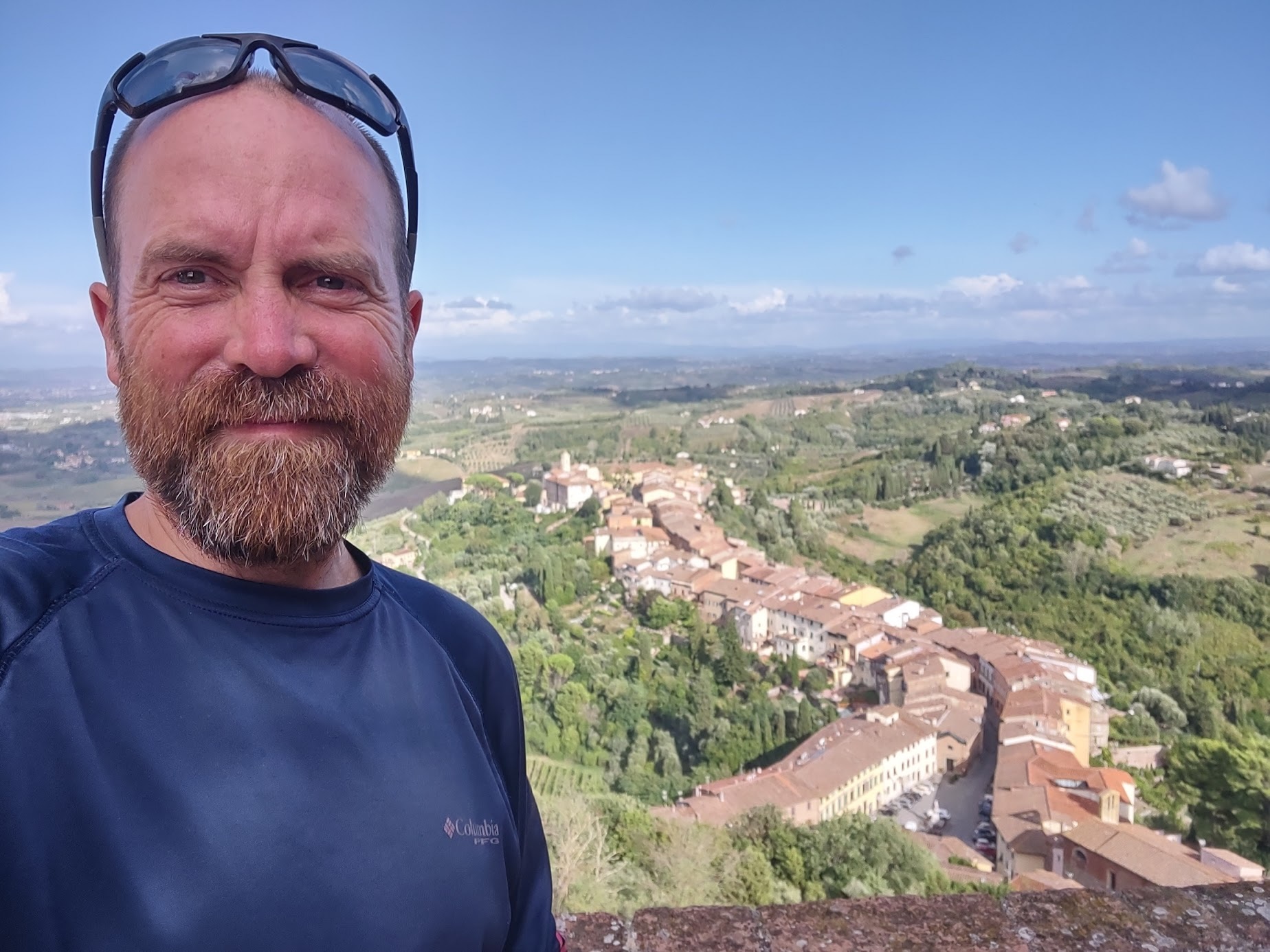
Dave Whitson is a 40-something-year-old high school history teacher and Camino de Santiago guidebook author who has crossed the United States on foot, spent six of the past twelve months traversing Italy, and taken countless student groups on long-distance walking adventures. He has no phone plan, gym membership, or anything resembling a vice. He writes powerful travel narratives, adores the challenge of working with sharp teenagers, struggles with relationships, thinks frequently about death, considers himself a sort of “parasite” on conventional society, and knows more about the Camino (and other modern pilgrimage routes) than pretty much anyone on earth. (davewhitson.com)
Full transcript: dirtbagrich.com/dave
Recorded in November 2025.
Transcript
This is an AI-generated transcript. Typos and mistakes exist!
Blake Boles (00:02)
Dave Whitson, welcome to Dirtbag Rich.
Dave (00:04)
Thanks very much.
Blake Boles (00:06)
What is the longest you’ve ever walked in one day?
Dave (00:11)
I had four days on the American Discovery Trail and the Oregon Trail when I was walking across the US coast to coast where I topped out around 50 to 51 miles. You know, there’s a little fuzziness when you get up to that distance, just how far you ended up. But based on the GPS, was, yeah, about 50, 51 miles. the first time I did it, I didn’t plan on it. It wasn’t like I had mapped out that goal for the day, but… ⁓
I was, it was sort of a classic situation for me where things were going wrong. The walking path that I was following was blocked by trail maintenance at times. They were, they were paving the bike trail.
And this was necessitating significant detours. And when I get angry, I walk faster. And then I also tend to walk farther, you know, like there might be a good reasonable choice about where to stop. Like there was a town I had in mind that I was going to camp at and I had to go ahead to stay in the park there from the local authorities. But I was just still so angry that I kept going. And then eventually I got to the point where it was I was over 40 miles and I’d never broken 50.
before and the it was dark already and there was nowhere good to camp regardless and so I just said screw it and I pushed on
Blake Boles (01:32)
Because getting up to a nice round 50 somehow held this appeal or like you could get revenge upon The the maintenance crews by by walking a bit farther at night
Dave (01:42)
I so. think I do think on some level, vengeance is important and useful as a walker, totally nonsensical vengeance, right? But it’s almost like redeeming something from a day that went wrong, you know, that it’s a it’s one way of salvaging a frustrating day. And, you know, I’ve I’ve learned over the years that when you get that wrathful energy, don’t waste it. Because if you try to go to sleep with it, it’s just not going to be a good
Blake Boles (01:57)
Hmm.
Hmm.
Dave (02:12)
night’s sleep. So you just burn that fuel off until that sucker’s dry and then you can you can sleep great again and you’ve you’ve managed to transform that into something constructive and useful.
Blake Boles (02:24)
I think you might’ve just found the topic for your next book, Dave, which is walking for revenge or wrath walking, spite walking. That’s very clickable right there. ⁓
Dave (02:27)
You
Spite walking, yeah.
It’s
a, you know, there’s a limit to it. There, you can end up feeling quite barren at the end of all of that. So it’s a dance, like a lot of things, but it’s useful to a certain extent.
Blake Boles (02:50)
Over the past two years, know that the past two years, 2024, 2025 have been a bit unique for you. What percentage of your year have you spent doing long distance walking?
Dave (03:02)
a lot. I set off basically at the very end of June 2024 to finish up the US walk. I finished that in mid October, so four and a half months there. Spent six months in Italy, walking over the course of 2025 and was even in Japan for a couple weeks on the Kumano Kodo as well. So let’s call it 11 months.
Blake Boles (03:26)
11 months out of two years.
Dave (03:28)
And really like one and half years, given that it started at the, yeah.
Blake Boles (03:30)
One and a half.
That’s right. Cause you stopped teaching for now or maybe forever in mid 2024. Is that right?
Dave (03:41)
Correct, yeah, so I wrapped that up in June and then a couple weeks later I took off on the walk, so it’s been a year and a half.
Blake Boles (03:45)
Yeah.
Yeah. And let’s say over the past 20 years, in an average Dave Whitson year, how long have you been walking? How many months or weeks have you been walking in an average year?
Dave (03:59)
Typically not more than, I don’t know, one and a half because I, or maybe probably averaging one and a half, a lot of years with at least, yeah, a lot of years with at least two months because, you know, the teaching schedule keeps me grounded for a lot of the time. In the end, you have about two months of downtime in the summer, but then, you know, a week in the spring, a week in December, and so often I would be taking students in the summer and those would be five-week trips and then it would be
Blake Boles (04:07)
months. Yeah.
Dave (04:29)
question of what else I could squeeze in around that and so often I would need to squeeze in a scouting trip in December or over the spring for one of the guidebooks I do with Cicerone so I would cram those into the margins and I would do the student trip and then I would see if I could eke out anything else in the summer.
Blake Boles (04:50)
So you just have this incredible productivity, this incredible reach it seems. You’ve written three Camino guidebooks, one book about pilgrimage. You’ve been running a podcast about the Camino de Santiago called The Camino Podcast since 2015. You’ve walked across the United States. You’ve walked back and forth across Italy and then the Middle East, Japan, all these other, I can’t even keep track. ⁓ Has your life really been teaching plus walking?
Are there any other significant aspects to the life of Dave that I’m missing out on here?
Dave (05:25)
Those are the two main things now. There was a time where I was balancing kind of two main…
forms of travel. One was the walking trips and the other was educational trips in post-conflict societies, sort of focused around the concept of truth and reconciliation commissions. And so each year my colleague Greg Benek and I would take students to Rwanda, South Africa, Chile, Argentina. And as the years passed, it just, it became difficult to keep doing both of those things. And so that slid off and the walking took over.
Blake Boles (06:02)
Let’s talk a little bit about money right up here up front. ⁓ Is the model for your life like live in Portland, Oregon, teach, save money, so spend less than you’re earning and then ⁓ spend out of your savings when you’re out there walking in some other part of the world. Is that more or less how it works for you?
Dave (06:05)
Yeah.
Yeah, it’s that simple. I don’t spend money. You know, I don’t have a phone plan. I don’t stream. I don’t have vices. I am remarkably boring.
Blake Boles (06:27)
Come on.
Dave (06:38)
I don’t pay for a gym, I go for walks or runs. I mean, think people just piss away so much money and some of that is valid and it makes their lives richer and it makes them happier. But I think a lot of it is just sort of done without much thought just because it’s conventional. And so if you just think about however much people are spending on their phone on a monthly basis, I don’t know if it’s 50 bucks, 100 bucks, wherever it falls for them.
Blake Boles (06:38)
Hahaha
Dave (07:07)
Like that right there is almost a flight to Europe depending on where you are. And so that opens up a lot of possibilities. And then the other thing that’s worked out really well for me over the years is that I’ve been able to combine interests. In other words, even before I was hired as a full-time teacher, I was organizing my first student walk on the Camino. And so those are all trips where I’m not paying to walk the Camino. And…
Blake Boles (07:11)
Mm-hmm.
Dave (07:34)
You know, you don’t make much money from guidebooks.
But in the end, hopefully you can at least break even on the scouting trips to write the guidebooks and balance some of that stuff out. And so over the years, I’ve been able to do a ton of travel where it’s not coming out of my pocket. And in a lot of cases, I’m actually getting paid to do it. And now as I’ve taken this time off to do additional walking, I just have so many miles socked away from all of those trips that I’m not paying to fly even now. So all of that has really worked well in
and feeding off one another to make things more affordable.
Blake Boles (08:11)
Hmm. As a fellow travel lover and outdoors lover who started a travel company so that I could travel to places I want to travel to and get paid to do it and work with cool teenagers along the way. I’m right there with you. ⁓ To be clear, do you have any outside sources of funding? Do you have a fantastic wealthy partner who you live with, family money, something like that? Anything that’s making this a lot easier for you?
Dave (08:19)
Hahaha.
No.
No, I don’t. What I would say in fairness is, you know, I come from a middle class family and when I quit my first teaching job, it was not a big deal for me to like crash on the couch between travel and when I went to university, I stayed local, I lived at home, my parents and I split the bill. So I had that kind of support over the years. Not everyone enjoys that level of support. But in terms of my day to day expenses, it’s all on me.
Blake Boles (09:10)
Yeah. Let’s go back to that time. Did you grow up in Portland? ⁓ Tell me what you studied and tell me how you kind of transitioned into the field of education.
Dave (09:21)
When I was really young, I was in California, spent most of my childhood, early adulthood in the Seattle area. So not in Seattle proper, but on the outskirts. And so I grew up in that area. I went to the University of Washington. I knew right from the beginning, because I was in public school through eighth grade. And then I went to a private school, an independent school for ninth through 12th grade for high school. And I was able to get a scholarship that was huge for
and be able to make that happen. But it was a completely different world because, you in public school the assumption is that if people are going to go to college, they’re going to go to the local university, the state school, or a junior college, a community college.
And suddenly I was surrounded by people who were talking about these far-flung private liberal arts schools all across the country that cost staggering amounts of money. And it is easy to get swept up in that. I see my students get swept up in that today. But for me, an organizing principle in my life, even as a teenager, was that I am never going to have debt. I am never going to have that anchor around my neck because
I recognized that even as I liked school, I was chafing against the lack of individual freedom, sort of quintessential teenager stuff. Like I wanted to be free. I wanted to have control over my choices. And I recognized that debt was a massive limiting factor. And so as they went and went all across the country to go to college, I lived at home and went to the University of Washington. And it’s the best choice I ever made to never have that burden hanging over me.
Blake Boles (11:04)
What did you study there?
Dave (11:07)
humanities. was in, I was a history and comparative literature major and you know, I had this this realization my senior year of high school. It was English class and we were all running class for individual sessions and at the end of it, I realized that like it was the most fun I’d had in a while that there’s something about teaching that you ⁓ get to become smarter all the time, hopefully if you’re doing it right. And there’s also a performative aspect to it.
Blake Boles (11:33)
Hmm. Mm-hmm.
Dave (11:37)
that it’s, there’s a certain high stakes aspect to it that every day you are going out before a live audience and it is a discerning critical audience. And so if you are complacent or lazy, you are going to get some icy glares. And so instead it pushes you pushes me and that was
Blake Boles (11:37)
Mm-hmm.
Dave (12:03)
motivational, motivating for me. It was exciting. And then on top of that, I also recognized as I looked at all of the different possible careers out there, there aren’t a lot of them that give you time. You know, there’s a lot to give you more money, but not many that give you time.
And so I always say like, summer’s off was always one of the huge factors that drew me to education because we just, time is the hardest resource to get and preserve and education offers that.
Blake Boles (12:36)
Well said. So you could have been a lawyer if lawyers had summers off or a computer programmer, if they had, you know, nice parts of the year off. Do you really feel like your career was a bit agnostic ⁓ to what the content was as long as the lifestyle opportunity was there?
Dave (12:55)
think so. I mean, I think that that’s fair because I have had thoughts over the years, you know, that the law has a performative aspect to it as well. And there is a certain degree to which it pushes you to learn.
You know, the great surprise, the great trick that was played on me when I went into education was that my assumption going in was that having to work with teenagers was gonna be the part I got paid for. know, like every job has the things that you enjoy and then the part that you’re actually getting paid for, because it’s what makes it work.
And in the end, it was the working with teenagers that has kept me in it over the years and proved to be the most motivating and exciting part of it. So I mean, I do think that if I had gone in other directions, it’s possible I would have, after a certain number of years, questioned whether it was fulfilling from a meaning perspective. And I have never lacked fulfillment or meaning working as a teacher with high schoolers.
Blake Boles (13:46)
Mm-hmm.
Hmm. Let’s dwell on this because the whole dirtbag rich project is about having sufficient time flexibility, which you’ve already discussed, having enough money to do what you want, but not so much that you’re sort of trapped or obsessed by it. But then also having this purpose, both purpose that comes from the work that you’re doing and what you’re doing with the free time that you’ve purchased yourself.
And so tell me what it is about working with teenagers that has kept you in this for so long and that feels rewarding and feels socially important.
Dave (14:25)
The teenagers I work with are, they’re fortunate in many cases, right, at least from a financial perspective. They have more opportunities, they go to a really good school. What that means is that I am working with students who are ⁓ well equipped, they’re prepared, and they’re…
often intrinsically motivated and if not they have enough extrinsic motivation to keep their head in the game and they come around to it. So I get to work with these students who have incredible capacity, high level of investment and for all the stereotypes about teenagers there is just an earnestness and openness that is lacking in a lot of adults that they want to improve, they want to be taken seriously
Blake Boles (15:11)
Mm-hmm.
Dave (15:14)
and the nature of being a teenager is that a lot of these profound life experiences you are going through them for the very first time in those years which just increases the intensity of the emotional reality of these young people and on one hand that is exhausting sometimes when everything feels like the worst thing or the best thing that ever has happened but on the whole it just brings
a ton of energy to the space. And I think for me, that’s the biggest thing is, you know, I want to be around people who surround me with energy because then I can reciprocate. You know, we can we can sort of build something out of that shared juice. And you don’t always get that in other cases. And so the the enthusiasm to learn the openness to be reflective and question their where they are, where they’re headed, what they care about.
⁓ And then just the degree to which it can be intimidating to know that you are surrounded by people who are as smart or smarter than you and they’re gonna challenge you and they’re gonna test you in the most positive and constructive ways, it’s elevating. And for me, that’s the big thing here is not just meaning, but also for me, what education has offered over the years is this,
appropriate challenge combined with a high level of autonomy. This is again a consequence of the kinds of schools I’ve worked at. I know there are a lot of teachers where they don’t have control over what they teach, they don’t have as much choice or say over that, and they have more complicated demographics that they’re working with. The schools that I’ve worked at, I have had just almost absolute autonomy to make decisions about what I’m gonna teach, how I’m gonna teach it, and that means that I obviously can focus on
Blake Boles (16:49)
Hmm.
Dave (17:14)
things that I’m passionate about in combination with things that are of critical importance to the students in terms of their capacity to engage with the world around them. And it’s always challenging me to master new material and to push the way that I teach. When you have control over things, you…
often are more self-critical, right? Because you have that level of investment and ownership. And so for me, that’s been huge over the years. I have always been able to see that next step in my development and progression and who I want to be. And my growth as an educator has propelled my growth as a person. In other words, I think that I’m a better person today because I was an educator as opposed to, say, a lawyer.
Blake Boles (18:04)
You anticipated my next question, which is how you deal with constraints of the school system, but it sounds like you’ve you’ve really had ideal circumstances in that regard. What about teaching history to teenagers? I have a guess as to how you make it interesting just based upon your writing, which is extremely compelling travel writing and narrative and adventure writing. ⁓ But history is just I think stereotyped as one of those subjects that
is tough to engage young people. And so what’s your approach to that?
Dave (18:40)
That whole concept is bizarre to me, right? How on earth could history feel inaccessible or irrelevant? And I guess the answer is when it is exclusively limited to what happened in the past. But any topic, you can find connections to the present and things that are happening right now.
that are important to the people in that room. And so that’s the most basic move is to just design your curriculum with the present in mind and think about how the past can help to explain the present, how the present can get us to engage in different ways with the past. I think sometimes schools…
get themselves into trouble by sort of locking in a particular time period, you know, that you have to do a survey over a set number of years within a geographic location. And, you know, that you can make that work. You can make anything work. There’s interesting material across every era. But if you start from a different sort of question or a theme or a topic that you really want to explore in much greater depth, then that’s the hook. Right. Like, it’s not about let’s talk about the ancient
Blake Boles (19:34)
Hmm.
Dave (19:56)
world, but it might be about how do we actually create a functional democracy? What does that look like? What does what does justice mean? How has it evolved over the years? Why is policing the way that it is in America? Obviously, I’m narrowing the scope there quite a bit. But with with any topic that is in the news and important today, there are fascinating tendrils that are that go far into the past. And those give you an opening.
Blake Boles (20:02)
Hmm.
Mm.
Dave (20:26)
to explore and make connections and transform history from something that’s purely an intellectual exercise to something that’s incredibly important and valuable, especially in a moment when people in power are constantly making reference to historical justifications that are not in any way grounded in fact. So it’s helpful if we can at least become a little bit historically literate in order to make sense of what’s happening around us.
Blake Boles (20:55)
Hmm.
Yeah, you’re making me realize what my favorite history books, which I’ve read in recent years, what they do. It’s compelling human stories, not just facts, numbers, ⁓ summaries, overviews, and then a lot of interesting connections to present beliefs and conflicts and stories. ⁓ So.
If anyone goes and reads what you’re putting out there on a regular basis, maybe an irregular basis, it’s fits and starts, right? And you’re on your blog or your Patreon or on the Instagram, which where you only post when you’re actually walking and then otherwise there’s nothing there. You’re a very good ⁓ storyteller. I’m kind of amazed at the depth of the history that you come together. And it makes me think that there’s no way this guy can be walking all day long through Italy or wherever.
because he must be sitting in some library asking someone for references and source books just to write this post. And so give me a little bit of insight into how you write your travel narratives as you’re going. Maybe there’s a slight of hand that I’m missing.
Dave (22:06)
No, there’s no slight of hand. It’s like a lot of things I do. It’s pure.
intellectual brute force, I guess, is a way to put it. One thing I’m not great at is efficiency. So I don’t, you know, I’m not using AI to give me a draft or anything like that. That would be horrific. So I’m thinking as I walk over the course of the day about what I’m seeing. So it starts by just reacting to what’s around me. And so sometimes I’ll go through ⁓ a church and I will see, you know, ⁓ a corpse, a body,
beneath one of the shrines in the chapel off the side. And then there will be a small plaque in Italian naming the person. Then, you know, I’ll get to my destination and I’ll see what’s out there about that person and try to learn about what the backstory is. And maybe there’s a story there. Maybe there isn’t. You know, there are a lot of lot of dead ends along the way trying to find interesting angles to write about. Sometimes it will be based on, you know, an audiobook that I’m listening to during
the walk. try to find audiobooks that I can listen to that inform the areas that I’m passing through and sometimes Libby comes through for me and sometimes it doesn’t. But I’m always trying to engage on multiple levels, audiobook, print books, or I suppose electronic books on the road. And then whatever signage or information I can find around me or what people are talking about if I get someone into conversation. So it’s always just like, what is the hook?
Blake Boles (23:11)
Mmm… Mm-hmm.
Dave (23:40)
What is the angle that I can dive into today? Because ultimately that’s the biggest challenge, especially now that I have been…
holding myself to this approach across the US walks and the Italy walks. know, that’s more than a year’s worth of daily posts or every other day posts. And the thing I don’t want to do is end up writing the same thing, you know, on different days. And so always finding some new angle, some new narrative hook. That’s the challenge.
Blake Boles (24:13)
Hmm. Have you ever been drawn to the long wilderness trails or are you more of a go through the old country and still be around people and cities and towns and more of that hybrid approach to long distance walking? Yeah.
Dave (24:30)
Yeah, the latter.
And, you know, I
suspect my theory is that when you look at the wilderness trekkers out there and the like Camino, the pilgrim walkers, you just can draw a lot of conclusions based on what their first significant experience was. You know, if you grow up doing wilderness treks, then I think that that’s always going to feel more natural, even if you become drawn to the creature comforts of what the pilgrim roads offer. I was never a wilderness hiker. Like I never
went camping as a kid that was just never something that was on the agenda and so the first long distance walk that I did was the Camino Frances and
that shaped my interests, my preferences, but you know, also my background in terms of the humanities, a history teacher. It makes sense that I’m also drawn to walking through places that have that historical significance, not that natural sites, that wilderness areas lack historical significance, but ⁓ the narratives are more obvious and compelling for me when I’m passing through towns along the way, and then also beautiful at parts
of areas of walking as well. So I’ve never been drawn to it. The walk across the US forced me to grow, you know, that I was walking through longer stretches where there was no civilization, you know, like Wyoming. And so I would have, you know, three day stretches where there wouldn’t be anything. I got used to having a bivy and a sleeping pad in my pack. And I’ve brought that back to pilgrimage now where I’m comfortable just sort of alternating.
But at the end of the day, like, I’m soft. I marvel at people who do wilderness treks for weeks and weeks at a time and endure the hardships of that. I have great admiration for it and I’ve just never pushed myself in that way and I’ve never been compelled to.
Blake Boles (26:28)
Hmm. I really find myself thinking about the social needs of someone. And I think a lot of the long distance wilderness walkers are really, ⁓ they’re interested in going on an interior journey, maybe figuring something out a lot of contemplation and are seemingly content to meet a few other people along the way who are probably pretty like-minded, ⁓ pretty demographically similar. ⁓ just like the level of fitness that you need to do something like that makes ⁓ people pretty similar.
When I did my first, I come from a definite wilderness bias background. And when I did my first Camino, Camino del Norte and the Primitivo in 2017, I thought, oh my gosh, there are so many different people from so many different backgrounds who are walking with me. And of course the people who are walking the same pace as me, that’s already something that will, that will create our own little bubble. But then getting to meet people along the way.
It was just such an incredibly rich social experience. And unlike you, I’m just not that much of a history or culture buff. I like speaking Spanish to people and I like kind of discovering little interesting tidbits here and there, but I’m very content to just be an ignorant walking person who meets nice people along the way and has really interesting conversations with them. And that is what drove me off the Pacific Crest Trail after just three weeks of hiking when I was age 22.
Dave (27:42)
you
Hmm.
Blake Boles (27:53)
I could handle sleeping in the dirt and on a thermo rest and the not showering and the eating repetitive foods and all the exposure to the elements. But it was the lack of like meaningful, deep and varied social interaction that I believe really, ⁓ sent me, sent me fleeing from that environment and straight into a summer camp. That’s where I went.
Dave (28:18)
Yeah, that’s a very different experience.
Blake Boles (28:20)
Yeah. Let’s go back to this moment where you had finished university and you were not yet a teacher, but you created this chance for yourself to take a group of high school students hiking on a Camino. Can you just tell me that story?
Dave (28:36)
Sure. So I made my first Camino 2002. At the end of it, realized that like, yes, this has got to be something that students do. And so I spent some time thinking about that while I was also working on getting.
hired as a teacher, eventually I decided to go ahead. got one of my old teachers to join me as the the co-leader for the trip and I got approval from my old high school to come in and pitch the trip. And I mean, this is the wild thing. Blake is just imagine you’ve got this this guy in his early 20s. He’s not employed anywhere as a full time teacher. He comes in and says to, you know, all of these
interested students and then later on to all the parents, all of these parents of these teenagers, guy in his early 20s comes in and says, let me take your kids out of the country for five weeks. We’re going to go walk across this route that nobody in America has heard anything about. Nobody knows anything about it because that was the case with the Camino in 2003. And give me money to do that. And it’s going to be great. I promise.
And we had more people apply than we had spaces. I don’t know how it happened. I don’t know what made it work. I’m sure the biggest selling point was that I had my colleague who had credibility, whereas I was just the talking head. it just came together so quickly, so easily, so seamlessly. And then there were some bumps in the road the first handful of days walking. by the end of the trip, when we were walking back from the lighthouse
Finisterre, the kids were already talking about what are we going to do next summer. And so that was just a sign of how well it worked that everything that I had hoped the Camino could be as a learning experience for young people, it immediately proved to be the case in every regard.
Blake Boles (30:38)
Hmm. And there’s a risk to taking something that you love and adventure that you had, and then trying to become the provider or deliverer or facilitator of that adventure. How did this work for you?
Dave (30:47)
You
Yeah, that’s a good question. On one hand, I think it helped that I’d only had one experience on the Camino at that point. I think that I had spent 10 years on the Camino doing all this different stuff. And then I thought, huh, I’m going to bring in high schoolers now. I think that that probably would have been higher risk just because I would already have such an established relationship with it. Whereas in this case,
Blake Boles (31:11)
Hmm.
Dave (31:17)
I barely had a relationship with the Camino because, you know, the first time on the Camino, it’s so hard, you know, it’s like for me, looking back, that’s such a different experience than all of my other Caminos because I had so much self-doubt, questions so much about whether I was going to make it. I was managing a lot of pain. I just didn’t know what I was doing. And so when I took students along, it was almost like, you know, I’m going to grow.
with the Camino at the same time that I’m gonna grow as a teacher. And so those two processes were mutually intertwined and they unfolded in unison. So I mean, I think for me, that’s been a powerful thing that those two parts of my life grew together. But what I would say was hard was, you know, anytime you go into something, you have a vision of how it’s going to work.
And I had this vision that it was basically gonna be school on the Camino. And so I had prepared all of these lectures and we were gonna get together and have these group meetings every day. And it was gonna be intensive learning along with the walking, along with everything else. And by the time we got to the end of the third day of walking in Pamplona, the wheels were falling off. Everyone was exhausted. We barely made it.
Blake Boles (32:16)
Hmm.
Mm-hmm.
Dave (32:40)
through that day in one piece, my co-leader was just like, I don’t even know if I can maintain this. they, you he was throwing out the idea of like, I think we probably need to take a day off. I think we probably need to think about restructuring some of these other things. And I mean, I vividly remember going to sleep that night in Pamplona and just thinking like this whole thing was about to crash and burn. And so, you know, I had to make some difficult choices and
I think the most difficult thing was to know what to let go of and what to hold very firmly to, even in the face of that doubt from my co-leader and maybe some of the students, because sacrificing those things would cost too much in the end and knowing that we could push through it. And so I think that that was the balance, was like how to be responsive and address the legitimate challenges.
without overreacting and maintaining confidence and faith in some key parts of the plan and the process. And for me, that was a pivotal learning experience as an educator because I do think, especially in recent years when we have tried to be more.
responsive to student mental health needs, that we can sometimes overreact and pull back too much. And I don’t think that that’s helpful for students in the end when we are overreactive. And so finding that sweet spot between being responsive but not overreactive, that’s something I learned on that first Camino with students.
Blake Boles (34:19)
So I’m curious, what did you decide to keep and what did you jettison?
Dave (34:25)
We jettisoned a lot of the lectures, a lot of the evening group stuff. We shifted it over to group meetings that were, it’s sort of communal, like reflecting on the day, some quick things, and some educational things we could slide in, but we didn’t take a day off. We kept the schedule, but we managed to just sort of build in more downtime over the course of the day, making sure that there was adequate time for people to rest and recover and do
Blake Boles (34:27)
Yeah.
Dave (34:55)
the things that the self-care routines that are important and some of that we were then able to fix right on that trip and then a big part of it was what we did better the next time because the training the packing a lot of those things we really nailed down and we didn’t have these these problems recur again so but but most of it was was was trimming away the the unnecessary stuff so figuring out what’s
What is essential, right? Like what’s mission critical for the experience and what’s nice to have, but not necessary.
Blake Boles (35:30)
I just want to linger here a bit longer. What is mission critical to have to get this full Camino experience? And of course we’re talking about in a group context. ⁓ Most people they go into it in it as an individual or maybe a couple of friends walking together context, but let’s just stick with the student group. ⁓ What is essential to have for a student for a teenager to walk away? So like, wow, that was a transformative experience rather than, wow, that was a nice walk through Spain.
Dave (36:01)
Yeah, that’s thanks for clarifying that because I do want to avoid any sort of dogmatic statement about like this is how you do the Camino because obviously people come from all different backgrounds, experience levels, physical capacities. And so there are lots of different ways to do it. My belief has been that with students, you need a long trip.
You know, one of the things that’s really clear in the research on educational travel, traveling abroad, is that the first week of a trip, that’s the entry process. You’re not really there yet. You’re just getting your feet under you. You’re getting over jet lag. You’re getting over all of these transitional challenges.
And the last week of a trip, you’re not really there either because you’re already thinking about home and you’re making plans and what you’re gonna do and who you’re gonna see. So if it’s a two week trip, you’re barely ever really firmly grounded in the place. So the starting point for me was it has to be a long trip. So five weeks, 500 miles, like that’s always been the benchmark. ⁓ And so that’s a starting point. Like they have to have…
enough time so that they aren’t looking back or forward, but they are just there. They are present in the moment. And second, I mean, I really do think, obviously there are exceptions to this.
But getting them through the walk day after day after day, I think is really important. It doesn’t always happen. on more than half the trips, we’ve had someone who we’ve needed to taxi ahead because they were really sick for a day, had like really serious cramps, had some sort of injury that they were managing, tendonitis or whatever.
But there are a lot more days where we just go slower. Maybe I carry a student’s pack for a while where we just like aggressively deal with all of the maintenance that is required to get through it because what.
I want the students to get out of the experience from an individual perspective is that self-belief, that recognition that I took on something hard, maybe it was something I didn’t really believe I could do. I encountered physical difficulties that I would just turtle up if I encountered at home and instead I kept moving through them. You know, if it’s hot, if it’s miserably wet, regardless of the
conditions, like same thing, I got my pack, I put it on my shoulders and I went out the door, or maybe, you know, I don’t have my pack, but I’m still doing it. And I just think that that is a powerful experience to carry forward. And in most cases, they do have that capacity, they don’t realize that they do. And so that’s incredibly important. And so that’s the individual, right? Like there’s there’s the group, there’s the social part of it and how they grow together with
Blake Boles (38:42)
Mm.
Hmm.
Dave (39:01)
with their peers and so getting them to not just walk with one or two people who they’re comfortable with but to get them to work on building relationships with others around them, learning what it’s like to be in a shared space day after day after day because we sleep in the dorms, we don’t do private rooms so we’re always there with each other, with others outside the group and meeting people from outside the US and so that’s a big part of it. But yeah, I think on an individual level,
want
them to be pushed into the deep end. I want them to go through some dark places because once they come out the other side, know, often, you know, one of the things that students will reflect on afterwards is like, I walked across a country. So like, why would I think that I can’t do other things?
Blake Boles (39:38)
Hmm
Mm-hmm.
Mm-hmm. Yeah, I can do hard things. That’s the takeaway. Yeah.
Dave (39:52)
Yeah, yeah, and
they don’t often get that message.
Blake Boles (39:56)
Yeah. Or the hard thing is very abstract and or academic, or I got into a certain college and fulfilled expectations. And this is just so visceral. And especially if they have some blister trauma or some day where there’s a bunch of horseflies attacking them, that’s just so much more, that’s a story to tell, which is so much more vivid than the typical stories of teenage achievement.
Dave (40:13)
You
Blake Boles (40:23)
linger just a little bit longer on the student travel part. And then I’m going to bring it back to you, the individual Dave. is there a moment that stands out from you leading student groups, ⁓ in which maybe it’s a kind of moment of, of meaning or transcendence where you’re like, wow, I am doing something super cool and enjoyable and meaningful because this just happened. just witnessed this and maybe it could be something super small.
But I’m curious if anything immediately pops into your head.
Dave (40:56)
There’s recency bias here. So the most recent student trip I did was a smaller one. Like I said, I prefer five weeks, but got to go back to my old school, help out with a walk on the Kumano Kodo in Japan. So that was a two week trip. And this relates to what I was just talking about in terms of the physical endurance. we had just an absolute monster of a day. Just a day, I mean, I think it was 7,000 feet of elevation gain and loss over the course of the day because we had to combine two stages because there wasn’t accommodation.
Blake Boles (41:25)
Wow.
Dave (41:26)
for a group our size on that particular branch of the the Kumano Kodo and then you sure enough we had had really good weather the entire time and then that day is the day when it was a downpour all the way through.
beginning to end and this was the second last day of the trip. So some of the students by this point were pretty strong, but a lot of them were a little raggedy because the Kumano Kodo is basically just non-stop up and down and it’s a lot of like rocky descents and steps to climb up. So it really does do a number on the knees and the joints and so some people were a little bit chewed up by this point and so it didn’t help that it was wet and it was cold and you got to worry about
leeches falling off of trees onto you and one one guy in the group just had just the worst knee pain that you could imagine and this was good this was a day where we didn’t really have a bailout ⁓ we it was just it was very rural
and we were just gonna have to push through it unless it was a real emergency situation. And so I just, I stayed at the back and I watched him just stare in horror when we would come to another steep ascent or even greater despair when that would become a sharp descent.
And every time he would just stare at it silently and he would summon his will and then he would push through it. And he did this time after time after time.
Another student was just sort of staying there with him the whole time and that student had managed some nasty chafing that day. But you he was cold, but he was not going to leave his friend’s side. And a third one had carried a bunch of food and she just kept throwing food at him. Every time we paused, it was like, here’s another snack from the bag and just sort of like kept him moving forward, kept getting his mind off of the intensity of
the pain that he was managing. And by the end of the day, like he was right there with the rest of the group when we made the final descent into town. We’d had a little concern just given the length and challenge of the day that we might not make it within the timeframe when dinner was served. We managed to get there like earlier than we had could have reasonably hoped we would make it given the challenge of the day. And he was right there with everyone else when they they went over to the hot springs to soak off the day and, you know, ate his
Blake Boles (44:03)
Hmm.
Dave (44:08)
His full fill at dinner. And so I just again it goes back to that I mean, I think so often we are we are setting the bar low with teenagers in terms of what they can do and we’re so scared of them failing and having to deal with failure and Here was a day where every single one of them can look back on it and think about this incredible challenge they tackled and for that group of three in particular the way that they held together and that the two got the other one
Blake Boles (44:18)
Mm-hmm.
Dave (44:38)
through because it was cold and it was wet and I’m sure they would have loved to have a longer break sitting down but they didn’t they stayed at the back and supported their peer through and that was you know every bit as admirable thing a thing to see as what the the injured student was navigating.
Blake Boles (44:56)
Hmm.
So even if you’re not primarily in wilderness context, it sounds like there are still these epic physically, seemingly impossible days that you or the students that you’re working with or other people you might be hiking with are dealing with. as we talked about in the very beginning, sometimes it’s a result of closures and unforeseen circumstances, a little bit of revenge walking in there. But, but you know, people can walk.
any kind of walk that they want. If they want to turn it into a physically grueling ⁓ suffer fest, they can. And I’m sure many do. And if somebody just wants to walk five or eight miles and linger and drink their espresso and read blog posts about whatever church they just passed by, they can do that too. Yeah, it’s.
Dave (45:47)
That
is the beauty of pilgrimage, that it is customizable on certain routes, right? Like the Camino Frances, the Cumano Cotto, there are certain sections where you can do really short distances and other ones where you can do longer ones. And one thing I just want to underscore is, neither with students nor individually do I want to make it ⁓ a suffer fest, right? Like for the most part, I really like walking long days and I don’t know what I would do if I were finishing at 11 in the morning every day, as some people do on the Camino.
Blake Boles (45:52)
Yeah. Yeah.
That’s
right.
Dave (46:17)
So for me, on the Italy walk, I think I was averaging just under 40 kilometers, 24 miles a day. And for me, that’s kind of the sweet spot.
Blake Boles (46:29)
This is a nice egg into the next thing I wanted to ask you, which is, do you feel like you’re monomaniacal in your love of walking? Do you have, ⁓ are there other parts of life that you feel like you may have traded away or even the S word sacrificed ⁓ in this relentless pursuit of long distance walking? Do you feel like you’ve missed out on anything, Dave?
Dave (46:55)
Well, I guess I have two answers to that question. One, I am sure I have missed out on things, right? Like, that’s the nature of life, that you make choices and you pick one thing and you miss out on the infinite other things that you could theoretically be doing. So I am sure that there are different versions of Dave that exist out there that are more content and happier.
on a day-to-day basis, that thought never enters my mind. So I don’t ever feel like, dang, I’m really missing out on some cool stuff there. I am super motivated and excited about whatever it is I’m throwing myself into. I mean, that’s the great thing about school is just, you know, we’re all on one-year contracts, basically. So every year, like, we would get a new letter inviting us to come back and we’d have that chance to make a decision.
every year that I was teaching, was teaching because that is the number one thing I wanted to do. Because again, I don’t live with debt. I live with savings. And so I do have that flexibility. I do have that option to leave, to vote with my feet if I’m not happy in a particular moment. And I would say the biggest challenge I had, the hardest thing was leaving the school to do the walking. it’s because, you the situation there is I wasn’t motivated to leave. I was motivated to go do this other thing, to challenge myself
in a different way. And as I told the students, it sucks that you can’t simultaneously be in two places.
because I would have loved to continue to be around the students. But it was a point in my life where it was time to go and test myself and challenge myself in a different way. you know, I just hadn’t had a lot of opportunities to immerse myself in a really long walk and see what that would be like and how that would unfold with having time to write about the experience afterward. And so it was the right time to push myself in that way. But no, on the whole, I don’t I don’t go around thinking like I’m missing out on
Blake Boles (48:49)
Hmm.
Dave (48:54)
this other stuff. I don’t feel that at all. You know, I do, suspect on some level that I would enjoy other things, but you know, it’s not on my radar at all and I am quite content with the choices I’ve made.
Blake Boles (49:20)
How does this work with relationships?
Dave (49:24)
⁓ I mean, it is a, there’s no question it’s a challenge. Like if you want to live an unconventional life, like that can create some complications in certain contexts. One of the things I learned about myself over the years is that I like myself the least when I am in a relationship in part because I, in a relationship, it just, it often felt like that would lose.
to whatever I was motivated to do at a particular time. like…
Blake Boles (49:57)
Can you,
I’m sorry, I don’t understand, what would lose?
Dave (50:00)
the relationship. other words, like, if I was like really in it at school, ⁓ if I was planning a walk, like I just had way more motivation to invest energy in that than in the relationship.
And so that was just something I discovered about myself over the years and had to come to terms with. And ⁓ so, I mean, I think that that, like, is that a personal failing on my part? Is that just another layer in which, like, what I’m motivated by is, like, unconventional? I don’t know. ⁓ But I definitely got to the point where I was single for a while and I didn’t miss it.
Blake Boles (50:44)
Hmm. This, this takes us into a bigger question. like to ask, which is like, how are you not made for this world? What aspects of modern society do you feel like you’re, you’re really truly unable to conform to or to play along with. You talked earlier about how people spend a lot of money without really thinking about it. And to you that it’s just sort of abhorrent and obvious. That’s not how you’re going to spend your resources. And you just told me that, ⁓
your motivation to teach or to go and on these walking adventures is like pretty much always going to win against the prospect of what people would call like a normal long-term stable relationship. What other ways do you feel like you are just like an alien living among us?
Dave (51:33)
You know, it’s interesting. I mean, obviously, I mean, I think the phone thing is the biggest differentiating factor is just the fact that I don’t live with a smartphone that is attached to a data plan. I don’t text. I don’t use most apps. So I do have like a smartphone. It functions off of Wi-Fi. I use it to listen to audio books and I use it for GPS.
but otherwise, now that I’m at home, it disappears. So I think for me, that’s probably the single biggest differentiating factor in terms of how I live in comparison to other people. What I would say is I don’t necessarily feel like an alien so much as, I don’t know, a parasite. ⁓ I am living quite well off of these structures that exist that other people are fully invested in.
Blake Boles (52:10)
Mm. Mm-hmm.
Dave (52:29)
the school that I taught at and do all the travel that I do, if people weren’t like deeply invested in the status quo and you know, pilgrimage would be a lot harder if there weren’t all of these people who were invested in that. And so all of these things that I enjoy and that I like to do, I just do them in different way than some people do. so I take advantage of all of the money and the investment and everything.
Blake Boles (52:52)
Hmm.
Dave (52:59)
else that goes into some of these structures and practices without being as being a central contributor to it. So I’m on the margins more than I am like in a different galaxy.
Blake Boles (53:09)
Mm-hmm.
Hmm. I’m really glad you said that out loud. This is something I think about all the time. ⁓ often when I’m off on some beautiful hike or trail run on some well-developed trail, that would be very ⁓ busy and crowded on a weekend or on a holiday. And I’m out there on a, on a Tuesday and it’s beautiful weather and there’s hardly anyone else. Maybe some retired people are out there walking their dogs, but I’m the only person in my broad age bracket who’s out there. Really.
Dave (53:29)
You
Blake Boles (53:43)
himself and I’m like I’m really glad that not that many other people have highly flexible work like I do and like it feels kind of bad to say that to myself because I want more people to to enjoy their lives and experience autonomy and have flexibility but at the same time it’s kind of nice to be the parasite ⁓ leeching off of everyone else’s more predictable schedules just to give us one example hmm
Dave (54:13)
you
Blake Boles (54:13)
The parasite, you called yourself a parasite. appreciate that Dave.
Dave (54:17)
You know, gotta be honest about these things. And you know, some parasites are important.
Blake Boles (54:20)
Yeah.
That’s
right. ⁓ Does it feel like your life is not working ⁓ in a long-term sustainable way? Are there any big unanswered questions or unresolved things that you’re still dealing with?
Dave (54:37)
Well… Look, I…
not to spin this in a weird direction. I am always mindful of death and that death is out there somewhere. so I, like, you asked me the age question. I literally never think about that. I don’t want to think about it. I don’t celebrate birthdays. So I like I’m I know that it’s it’s out there. I know that at some point, I’m going to start tipping past my sort of peak abilities as a walker at some point, like I’m going to actually get sick and get
injured and I live in a country where I’m gonna have to figure out healthcare which is something that I just sort of shoved to the side when I quit my teaching job. If I lived in literally any other developed country that wouldn’t be something I have to worry about but it’s something that I have to think about here. So I mean I think that that is the single biggest factor that will shape some of my decisions here you know not too far down the road. Like this is not something that I can do forever if for no other reason than the healthcare situation.
Blake Boles (55:21)
Hmm.
Dave (55:42)
in America, but you know, other factors will inevitably come into play as well. ⁓ so, I mean, I think that that’s the variable is just like being old in America is expensive. And so I can be cheap and middle-aged in America, no problem, but there’s a tipping point.
Blake Boles (55:43)
Mm-hmm.
Hmm.
Hmm. When you’ve been walking in Europe or let’s say anywhere else, have you met any, any really old walkers who just say, this is what I’m doing until, you know, my legs will literally not work anymore. And if so, how old were they?
Dave (56:23)
I may have encountered them, I haven’t gotten into a conversation with them, but I know it’s out there because there’s a book by Ian Reader who I interviewed for the podcast. I think it’s Pilgrims Until We Die about this phenomenon in Japan of people just going to the island of Shikoku and just walking around and around and around into old age.
And there are some people who are known on the Camino for just essentially being homeless and just walking the Camino all the time. So it’s something that some people have decided to pursue and, you know, there are worse ways to spend your golden years.
Blake Boles (57:09)
Do you see yourself in that sort of vision?
Dave (57:11)
I have no idea. I don’t predict the future.
I who knows right like what’s exciting is that I have now made it through these two giant walks the US and Italy and I haven’t finished thinking like well I’m glad that’s over I don’t need to do that again so I haven’t burned out on it I still really enjoy it but I’m also cognizant of the fact that like I’m still at a point where the walking is easy for me and what will it be like when the walking is hard for me that’s something I’m gonna have to learn about because I
haven’t had to. Like I have been immensely fortunate when it comes to that. And so we’ll see what happens. But yeah, mean, you know, you make predictions about the long term future and then, you know, God laughs at you, right? So that’s, that’s what happens. So I really don’t have like super long term plans. Like I live in a way where I’m not like
Blake Boles (58:02)
Mm. Mm.
Dave (58:13)
putting myself in a super vulnerable position, right? Like I’m not burning through everything I have. Like I’m very conservative when it comes to that stuff. So like I know that I’m still in a good position for moving forward, but I really have no idea what I’ll be doing five to 10 years from now.
Blake Boles (58:30)
Hmm. What’s on the horizon in terms of next walks? I know you’re hunkering down to write about Italy and finished writing the book about the American discovery trail. But beyond that, anything you can share with us.
Dave (58:44)
Well, I’m overdue now to revisit the walks in the guidebooks. So that’s definitely a priority. I, you one of the things that I’m going to be working on with the, the Commune del Norte, which is on the north coast of Spain is just adding again to the kinds of variants, the different ways that you can get off the route where it might be more interior, more paved and see more of the spectacular coastal scenery along the way. So I’ll be working on that. I’ll be fleshing out that book and then we’ll be peeling off.
off
the Camino Primitivo part of it and adding the Camino Salvador, which is another sort of mountain walk that links with the Primitivo in Oviedo. So there will be some scouting of places I haven’t walked yet, some revisiting of routes that I have walked, and that will take up a chunk of time. So that’s the practical and maybe boring answer in terms of what’s next. And then down the road, it’s a question. So we’ll see.
I’m definitely facing now a pretty major backlog of stuff that I need to write about.
Blake Boles (59:50)
Mm-hmm. And will you be going back to the classroom?
Dave (59:55)
They have no idea.
Blake Boles (59:56)
Okay, you’re really
okay with just not knowing what’s coming down the road, it seems, aside from I need to finish my writing projects. ⁓
Dave (1:00:04)
Yeah,
I mean, it’s a luxury. And I would love to be around students again. Like, I’d definitely miss that. I don’t know if I could teach, you know, five history classes all in a row, ⁓ as I did at the beginning of my career. Like, one of the challenges is that I had, like, the best job in education one could have. That’s why I stayed for a really long time. And so to figure out, like, what would be an appealing…
teaching role, education role that would draw me back, that would have me motivated to work at the level that I expect of myself, which is a very high level. Like I’m not sure what that role would be. So that’s part of the uncertainty is that I’m not just gonna go out tomorrow and apply for 20 different full-time teaching positions. I’d be looking for something a little bit more distinct.
Blake Boles (1:00:48)
Hmm.
And for anyone who wants to everything that you do online, is there possibly a central repository website that we can point them toward?
Dave (1:01:11)
you
Yeah, fortunately there is, DaveWhitson.com, W-H-I-T-S-O-N. And so that’s the home for it. There is a ⁓ Patreon that people can sign up for if they want to, and that’s beautiful. And it has like a ton of other stuff packed in. So if you haven’t looked at that before and you are looking for something to read that will keep you busy for a few weeks, you can definitely find it at DaveWhitson.com.
Blake Boles (1:01:40)
Dave, thanks so much for coming on Dirtbag Rich.
Dave (1:01:42)
Thanks for having me, Blake.